
Definition
Anterior iliopsoas impingement refers to mechanical irritation of the iliopsoas tendon as it passes over the front of the hip joint. It can cause anterior or groin pain, sometimes associated with snapping hip, particularly when moving from flexion to extension.
In reality, the term covers several related but distinct situations: iliopsoas tendinopathy or tendinobursopathy, mechanical impingement between the tendon and the anterior structures of the hip, internal snapping hip (or coxa saltans interna), irritation of the iliopsoas bursa, impingement associated with a morphological abnormality of the hip, or irritation secondary to hip surgery or a hip replacement.
In runners, the condition is most often linked to repetitive overload of the hip flexor, but a mechanical abnormality can perpetuate the symptoms. It is therefore important to look for a possible associated condition: femoroacetabular impingement, labral tear, dysplasia, adductor tendinopathy or a pubic condition.
These different mechanisms (tendinopathy of the tendon, bursopathy of the surrounding bursa, mechanical impingement during certain hip movements, and internal snapping when the tendon moves perceptibly) are often used interchangeably in everyday language, but they do not describe exactly the same thing. They can also coexist in the same patient.
Anatomy
The iliopsoas is the main flexor of the hip. It is made up of two muscles, the psoas major and the iliacus, which join together towards the lesser trochanter of the femur. The common tendon passes in front of the hip joint before inserting there.
An iliopsoas bursa lies between the tendon and the deep structures of the hip. This bursa can become inflamed and itself contribute to the pain, independently of or in association with tendon involvement.
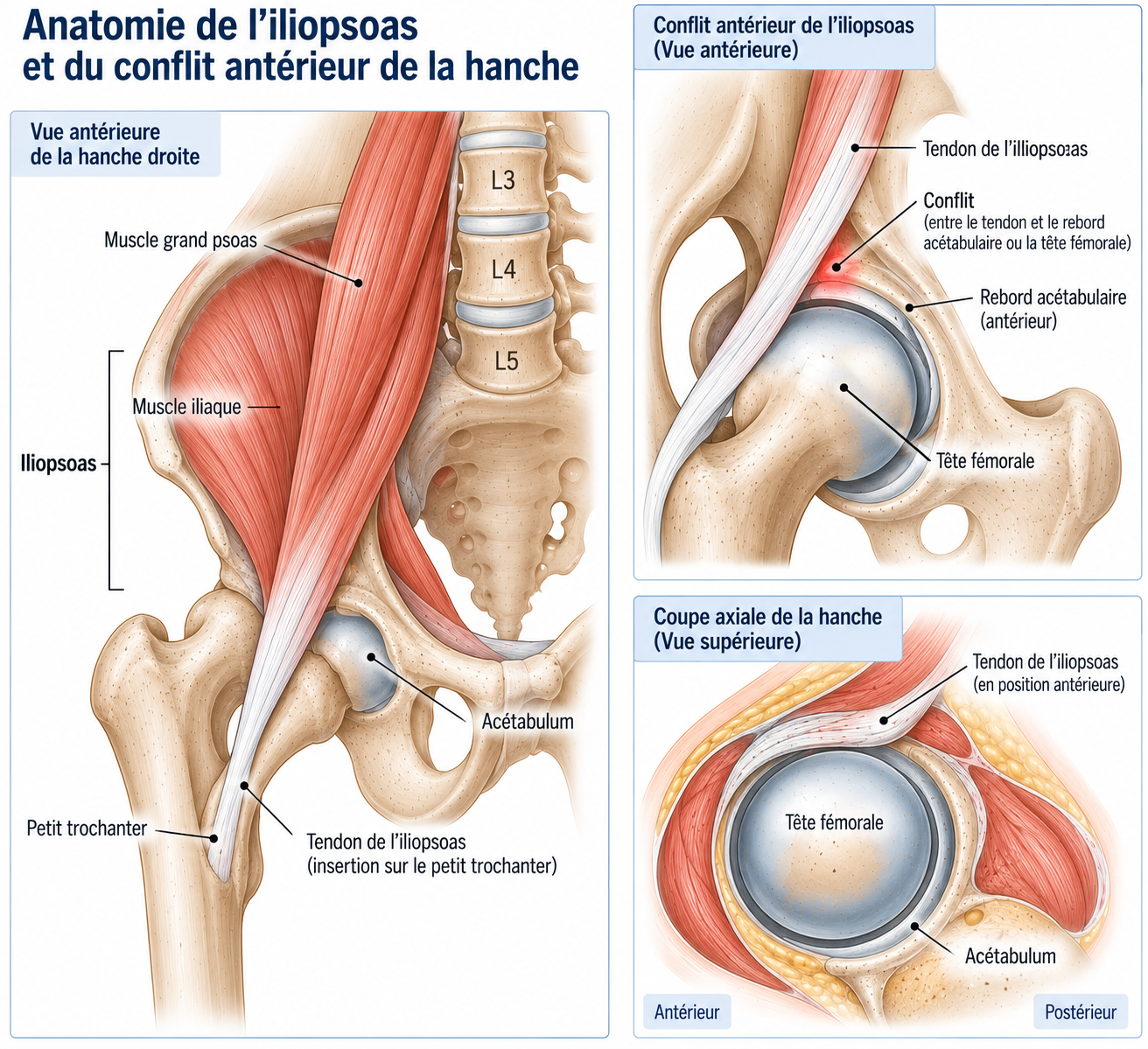
🔍 Click on the image to enlarge it
Role of the iliopsoas in runners
The iliopsoas is mainly involved in hip flexion, stabilisation of the femoral head, pelvic control, rapid thigh movements and bringing the lower limb forward.
In runners, it contributes in particular to bringing the thigh forward during the swing phase of the stride, preparing for foot contact, pelvic control, running uphill and accelerations. It therefore works thousands of times in every session, which explains its vulnerability to repetitive overload.
Epidemiology
Anterior iliopsoas impingement is a common cause of groin or anterior hip pain in runners, often linked to repetitive overload of the hip flexor during the repeated flexion, extension and accelerations of running.
Internal snapping hip, a frequently associated component, is a common and often benign finding: isolated, painless snapping does not necessarily indicate a disorder and does not systematically require treatment. The problem becomes truly pathological when the snapping is painful, repetitive, associated with functional limitation or responsible for reduced performance.
Persistent groin pain in a runner should also always prompt a search for a possible associated intra-articular condition (femoroacetabular impingement, labral tear, dysplasia), which can alter the muscle strategy around the hip and perpetuate the symptoms.
Causes & risk factors
The iliopsoas tendon can be heavily loaded when the hip repeatedly performs flexion and extension movements, rapid movements, changes in range of motion and accelerations.
Situations that increase loading
Certain training situations particularly increase the load on the tendon: a sudden increase in mileage, interval training, hills, trail running, speed work, returning after a break, a change in running technique, or a substantial increase in elevation gain. Muscle fatigue can also alter the hip stabilisation strategy and promote irritation of the tendon.
Contributing factors
In terms of training, the same situations as above are found: a sudden increase in volume, too rapid a return, interval training, hills, trail running, repeated accelerations, long sessions and insufficient recovery.
In terms of muscles, a strength deficit of the gluteus medius, weakness of the gluteus maximus, a trunk deficit or overall weakness of the lower limb can contribute to overload of the hip flexor.
In terms of mobility, limited hip mobility, a thoracic mobility deficit or poor ankle mobility can also play a role. However, a single isolated deficit should not be regarded as the necessary cause of the impingement: these factors usually combine rather than act alone.
Influence of hip morphology
Certain hip morphologies can alter the stresses placed on the iliopsoas: femoroacetabular impingement, cam morphology, pincer morphology, dysplasia or abnormalities of the acetabular rim. An intra-articular injury can also cause a change in the muscle strategy around the hip. In a patient with persistent groin pain, a possible associated intra-articular condition should therefore always be looked for.
Symptoms
Groin and anterior pain
The classic presentation is deep anterior pain located in the groin; the patient can sometimes point to the painful area with one finger. The pain may appear when climbing stairs, getting into a car, running, accelerating or running uphill.
Some patients feel pain when moving from sitting to standing, or when moving from a flexed hip to an extended hip. An anterior clunk may also be felt during the movement, sometimes loud enough to be audible.
Running-related pain
In runners, the pain may appear at the start of a run, after several kilometres, during accelerations, on hills, with a long stride or after a demanding session. Some runners feel little pain during training but have pain after the session, when walking, climbing stairs or moving from sitting to standing.
Night pain or pain at rest
Mild pain after strenuous activity may be consistent with simple tendon overload. However, significant pain at rest or at night, or pain persisting for several days, should lead to a reassessment of the diagnosis and a search for an intra-articular condition, a stress fracture, an inflammatory disorder or a significant muscle condition.
Internal snapping hip
Internal snapping refers to movement of the iliopsoas tendon during certain hip movements. It can be audible, palpable, visible, painful or completely painless. It classically occurs when moving between flexion and extension, sometimes with a deep clunking sensation in the groin.
Isolated, painless snapping is often a benign finding and does not necessarily require treatment. The problem becomes pathological when the snapping is painful, repetitive, associated with functional limitation, or responsible for reduced performance.
Clinical examination
The examination assesses the precise location of the pain, hip mobility, pain on resisted flexion, pain on stretching the iliopsoas, snapping, muscle strength, pelvic stability and any intra-articular pain. Palpation of the iliopsoas region may reproduce the pain: the Doha agreement considers that the combination of pain on palpation of the iliopsoas with pain on resisted flexion and/or on stretching of the flexors makes iliopsoas-related pain more likely.
The resisted flexion test involves performing hip flexion against resistance; it is considered positive when it reproduces the patient’s usual pain, and not simply muscular discomfort, since a strong contraction of a poorly trained muscle can be uncomfortable without indicating a disorder.
The iliopsoas stretch test gradually takes the hip into extension, possibly with the knee flexed; reproduction of the usual pain may point towards iliopsoas involvement. However, no single test can confirm the diagnosis with certainty: a systematic review published in 2026 highlights that the available clinical tests remain imperfectly validated and that current diagnostic data are still limited.
Testing for snapping involves looking for a reproducible hip movement that triggers the clunk, often provoked by a combination of flexion, abduction and external rotation, followed by a return towards extension and internal rotation. Dynamic ultrasound can directly visualise the movement of the tendon and is a particularly useful examination when the snapping is difficult to demonstrate clinically.
Further tests
X-rays
Look for femoroacetabular impingement, osteoarthritis, dysplasia, a bone abnormality or a fracture. Particularly useful when pain persists or when an intra-articular condition is suspected.
Ultrasound
Allows assessment of the tendon, the bursa, the muscle and the periarticular structures. Its main advantage is its ability to perform a dynamic examination, showing the movement of the tendon responsible for the snapping; it can also be used to guide a possible diagnostic or therapeutic injection.
MRI
Allows examination of the iliopsoas tendon, the muscle, the bursa, the labrum, the cartilage and the bone. Particularly useful when another condition is suspected: labral tear, associated femoroacetabular impingement, muscle injury, stress fracture or cartilage damage.
Diagnostic injection of the iliopsoas bursa
An ultrasound-guided injection of local anaesthetic makes it possible to check whether the usual pain decreases during a movement or activity that is usually painful, which helps distinguish extra-articular iliopsoas pain from intra-articular hip pain. It may have a temporary therapeutic effect but should not be regarded as absolute diagnostic proof.
Differential diagnoses
Femoroacetabular impingement
Groin pain associated with pain on hip flexion/rotation.
Labral tear
Deep pain, sometimes associated with intra-articular clicking or catching.
Adductor tendinopathy
Groin pain associated with pain on resisted adduction.
Pubalgia
Groin or pubic pain, often multifactorial.
Rectus femoris tendinopathy
Anterior hip pain, to be distinguished from the more medial/groin pain of the iliopsoas.
Femoral neck stress fracture
An important diagnosis not to be missed in runners: deep groin pain, a recent increase in load, increasing pain, pain when walking, at night or at rest, limping, reduced weight-bearing capacity. It requires impact to be reduced immediately and an appropriate medical assessment to be obtained.
Hip osteoarthritis
To be considered particularly in older runners.
Referred lumbar pain
A lumbar spine condition can cause pain referred to the groin.
Sacroiliac condition
Can cause atypical buttock or groin pain.
Classification
Grade 1 — Mild irritation
Occasional pain, running possible, snapping causes little discomfort, no significant limitation.
Grade 2 — Symptomatic impingement
Regular pain, discomfort when running, pain on resisted flexion, pain after sessions.
Grade 3 — Significant impingement
Frequent pain, limited running, discomfort in daily life, repeated painful snapping, reduced strength.
Grade 4 — Resistant form or associated condition
Symptoms persisting despite rehabilitation, significant mechanical impingement, possible associated intra-articular injury, disabling pain, highly symptomatic snapping.
Treatment
General principle and initial reduction of irritation
Most cases of iliopsoas impingement or snapping can initially be treated conservatively. Treatment is based on load adjustment, reducing irritating movements, restoring mobility, progressive strengthening, pelvic control and a gradual reintroduction of running. The available data suggest high success rates with conservative management in idiopathic and athletic populations, although the quality of studies remains variable.
Sprinting, interval training, hills, technical trail running, explosive movements and repetitive loaded hip flexion exercises are temporarily reduced. Running can sometimes be continued if it causes few symptoms: complete rest is generally not necessary.
When deep hip flexion triggers the symptoms, deep squats, very deep lunges, repeated knee raises and very low sitting positions can be temporarily limited. This limitation remains temporary: the aim is not to permanently protect the iliopsoas from all stress.
Restoring hip mobility
Mobility should be regained gradually by working on hip extension, active mobility, thoracic mobility and ankle mobility. Iliopsoas stretches can be used if they are well tolerated, but aggressive or repeated stretching in a range that clearly reproduces the pain should be avoided.
Strengthening the glutes (gluteus maximus and medius)
The gluteus maximus plays a major role in hip extension: progression typically goes from the glute bridge to the hip thrust, with a gradual increase in load, then to the deadlift (loaded hip extension) and the split squat, gradually deeper.
The gluteus medius, for its part, contributes to pelvic control: hip abduction, clamshell, lateral band walk, step-up and single-leg squat all work towards this goal of stabilising the pelvis during stance.
Progressive strengthening of the iliopsoas and trunk work
Strengthening the iliopsoas should not necessarily be avoided permanently: on the contrary, the ultimate aim is to restore its capacity to produce and control hip flexion. Progression can go from a light isometric contraction, to hip flexion against low resistance, to work in partial range, to dynamic work, to progressive loading and then to rapid movements, always staying below the irritation threshold.
Pelvic and trunk control helps reduce certain compensations: plank, side plank, dead bug, bird-dog and Pallof press. The aim is not to have a constantly rigid trunk but to be able to control the pelvis effectively during rapid movements.
Single-leg work and reintroduction of speed
Running is a succession of single-leg stances: single-leg balance, step-up, step-down, single-leg squat, lunge and single-leg hops help develop pelvic stability, knee and hip control, and trunk coordination.
Before resuming fast sessions, brisk walking, easy running, progressive accelerations in a straight line, short then long intervals, and finally hills are gradually reintroduced.
Return to running and the 24-hour rule
A possible progression: easy running on flat ground, gradually increasing duration and then distance, reintroducing accelerations, reintroducing elevation gain, returning to trail running, then returning to specific sessions. It is preferable not to increase volume, speed and elevation gain at the same time.
A session is generally acceptable if the pain remains low, does not gradually worsen, the snapping does not become progressively more painful, and the symptoms quickly return to their usual level. If the pain remains clearly increased the next day, the load should be reduced.
Complementary treatments
Anti-inflammatories (NSAIDs)
Can be used occasionally to reduce pain, bursal inflammation and post-exercise discomfort, but they do not correct the mechanical cause. Their use must take into account age, kidney function, digestive risk, cardiovascular risk and concomitant medications.
Iliopsoas bursa injection
May be considered when pain persists despite appropriate management, when bursopathy is suspected, when the diagnosis needs to be clarified, or when a temporary reduction in pain can make rehabilitation easier. The effect is often mainly symptomatic and should not replace strengthening and load modification; recent data suggest short-term improvement in a proportion of patients, but the long-term benefits are less certain in mechanical forms.
Surgery
Surgery is rarely necessary. It may be considered in selected situations: persistent painful internal snapping, failure of properly conducted conservative management, clearly identified mechanical impingement, or an associated intra-articular condition requiring arthroscopy.
The procedure may involve lengthening or partial release of the iliopsoas tendon, but this procedure should be considered with caution: excessive release can lead to weakness in hip flexion, psoas atrophy, altered stability and functional deficit. A recent systematic review also highlights the current uncertainty about the specific benefit of iliopsoas release in native hips, and reports a risk of reduced flexion strength and muscle atrophy.
In some patients, the problem is not just the tendon: cam impingement, pincer impingement, a labral tear or cartilage damage may coexist. In these situations, arthroscopy can treat the intra-articular lesions and the associated mechanical impingement at the same time, with the decision depending on a full assessment of the hip. The general principle of the guidelines on femoroacetabular impingement is that surgery should only be considered when symptoms, clinical examination and imaging are consistent with one another.
Recovery time
After surgery, recovery depends on the procedure performed (iliopsoas lengthening, labral repair, cam/pincer correction) and on the recovery of strength. Rehabilitation is progressive: recovery of mobility, muscle activation, strengthening, single-leg work, impacts, running, speed and then sport-specific work. Return to running generally takes place after several weeks to several months depending on the procedure performed; there is no universal timeframe.
Before resuming regular running, the ideal is to have minimal pain in daily life, functional mobility, no significant painful snapping, sufficient hip strength, good trunk strength, good single-leg stability, good tolerance of jumping, and no significant symptomatic reaction the next day. Progression is then guided by tolerance rather than by a fixed schedule.
Prevention
It is not possible to prevent all iliopsoas problems, but certain strategies can reduce episodes of overload.
In terms of load progression, sudden increases in mileage, speed, hills and interval training should be avoided. In terms of strengthening, it is useful to maintain the strength of the glutes, quadriceps, hamstrings, iliopsoas and trunk muscles.
Single-leg work helps maintain good pelvic control, and sufficient recovery between intense sessions helps avoid the accumulation of load without adaptation.
Frequently asked questions
What is iliopsoas impingement?
Why does my psoas snap?
Is it serious?
Can I run with snapping hip?
Should I stretch my psoas?
Should I strengthen my psoas?
Is cycling allowed?
Should trail running be avoided?
Is an injection effective?
When should an ultrasound scan be done?
When is an MRI needed?
When is surgery needed?
Common mistakes
Thinking that a painful psoas is necessarily a "too short" psoas that needs constant stretching.
Assuming that you have to stop running completely as soon as symptoms appear, when adjusting the load often makes it possible to keep active.
Believing that a snapping tendon means it is going to rupture: painless internal snapping can be completely benign.
Limiting yourself to core stability exercises without restoring the capacity of the whole lower limb.
Strengthening only the glutes without gradually restoring the capacity of the iliopsoas itself.
Thinking that an injection cures the impingement, when it often only reduces the pain temporarily.
Wanting a surgical release of the psoas as a first-line treatment, when surgery is reserved for selected situations and carries a risk of flexor weakness.
Assuming that a clunk always proves a labral tear, when the snapping may be extra-articular and come directly from the iliopsoas tendon.
Key points — Institut Basque du Coureur
A snapping psoas is not necessarily a diseased psoas: internal snapping hip can be completely painless and then require no treatment at all. When it becomes painful, the search should be for iliopsoas overload, bursopathy, mechanical impingement, femoroacetabular impingement, a labral tear or another cause of groin pain. Diagnosis is based mainly on symptoms, clinical examination and functional analysis, with appropriate imaging when necessary; dynamic ultrasound is particularly useful for demonstrating tendon snapping. Treatment is generally based on temporary load adjustment, reducing irritating movements, regaining mobility, progressive strengthening of the iliopsoas and glutes, trunk work, pelvic control and the gradual reintroduction of impact and running. The aim is not to rest the psoas indefinitely, but to gradually restore its capacity to withstand the stresses of running. Finally, when surgery is being considered, it must be very carefully thought through: releasing a tendon that actively contributes to hip flexion and stability is not a trivial procedure.
- Weir A, Brukner P, Delahunt E, et al. Doha agreement meeting on terminology and definitions in groin pain in athletes. Br J Sports Med. 2015;49:768-774.
- Yen YM, Lewis CL, Kim YJ. Understanding and Treating the Snapping Hip. Sports Med Arthrosc Rev. 2015;23:194-199.
- Byrd JWT. Evaluation and management of the snapping iliopsoas tendon. Instr Course Lect. 2006;55:347-355.
- Thomas Byrd JW. Internal snapping hip syndrome. Am J Sports Med. 2002.
- Takla A, O'Donnell J, Voight M, et al. The 2019 International Society of Hip Preservation (ISHA) physiotherapy agreement on assessment and treatment of femoroacetabular impingement syndrome. J Hip Preserv Surg. 2021;7:631-642.
- Griffin DR, Dickenson EJ, O'Donnell J, et al. The Warwick Agreement on femoroacetabular impingement syndrome. Br J Sports Med. 2016;50:1169-1176.
- Jimenez AE, et al. Competitive athletes with femoroacetabular impingement and painful internal snapping treated arthroscopically with intrabursal iliopsoas fractional lengthening. Am J Sports Med. 2022.
- Idjadi J, Meislin R. Symptomatic snapping hip: targeted treatment for maximum pain relief. Phys Sportsmed. 2004;32:25-31.
- Blankenbaker DG, De Smet AA, Keene JS. Iliopsoas bursa imaging: efficacy in depicting abnormal iliopsoas tendon motion in patients with internal snapping hip syndrome. Radiology. 1993.
- Hip-related groin pain and iliopsoas-related groin pain: current evidence and clinical assessment literature.
- Clinical Diagnosis and Treatment of Iliopsoas-Related Groin Pain: A Systematic Review. 2026.
- International consensus and contemporary rehabilitation literature on hip-related groin pain, femoroacetabular impingement and return to sport.
Similar injuries
Anterolateral TFL impingement
Anterior hip irritation associated with overload of the tensor fasciae latae.
Femoroacetabular impingement
Abnormal contact between the femoral head and the pelvis, causing groin pain.
Gluteus medius tendinopathy
Pain on the outside of the hip caused by irritation of the gluteus medius tendon.