

📊 Mechanical stress at a glance
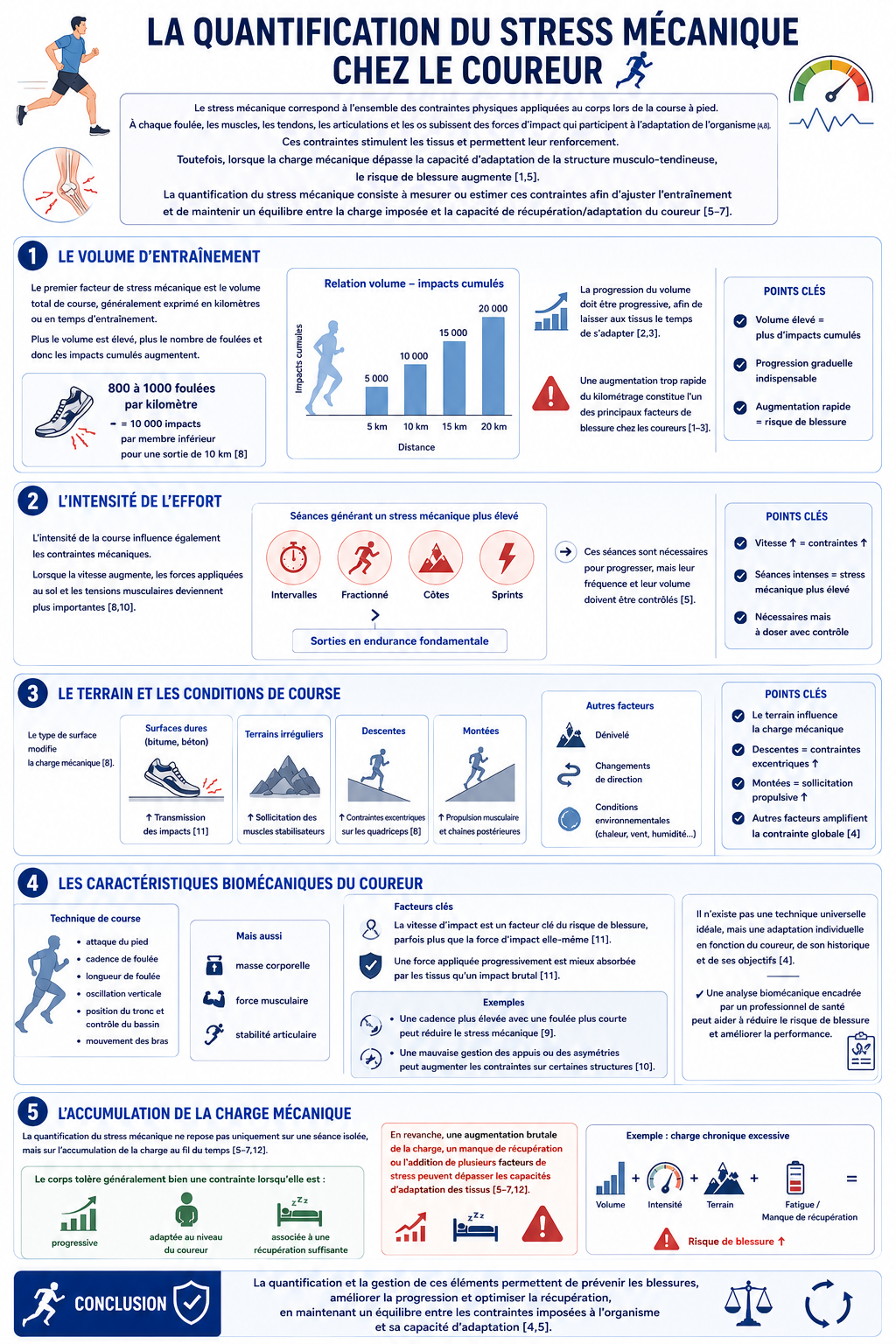
Visual summary of the mechanical stress factors in runners.
🔍 Click to enlarge
Mechanical stress refers to all the physical stresses applied to the body when running. With each stride, muscles, tendons, joints and bones undergo impact forces that contribute to the body’s adaptation. [4,8]
These stresses stimulate tissues and allow them to strengthen — but when the mechanical load exceeds the adaptive capacity of the musculotendinous structure, the risk of injury increases. [1,5]
🔍 Click to enlarge
Key message: Quantifying mechanical stress means measuring or estimating these stresses in order to adjust training and maintain a balance between the load imposed and the runner’s recovery capacity. [5–7]
⚙️ The 4 main mechanical stress factors
The total number of kilometres or running time — and therefore the cumulative number of strides and impacts on the structures.
[8]Running speed and type of session: the higher the intensity, the greater the forces applied to the ground.
[4,5]The type of ground, elevation changes, changes of direction and environmental conditions alter the mechanical load.
[8,11]Running technique, cadence, body mass, muscle strength and joint stability influence the stresses experienced.
[4,8]📐 Volume and intensity: the two main levers
Total running volume is the leading mechanical stress factor. A runner takes about 800 to 1,000 strides per kilometre, i.e. nearly 10,000 impacts per leg for a 10 km run. [8]
- The more volume increases, the more impacts accumulate
- Progression must be gradual to let tissues adapt [2,3]
- Increasing mileage too quickly is one of the leading injury factors [1–3]
As speed increases, ground reaction forces and muscle tension become greater. [8,10] High-intensity sessions generate more mechanical stress than easy endurance runs. [4,5]
- Intervals & speed work
- Hill sessions
- Sprints
🏃 The runner’s biomechanical characteristics
Mechanical stress also depends on each runner’s own characteristics. Two people running the same volume at the same pace may experience very different stresses. [4,8]
- Foot strike (heel / midfoot / forefoot)
- Cadence
- Stride length
- Vertical oscillation
- Trunk position & pelvic control
- Arm movement
- Body mass
- Muscle strength
- Joint stability
- Injury history
- Asymmetries in foot contact
Studies show that impact speed is sometimes more decisive than the impact force itself in injury risk. [11] A force applied gradually is much better absorbed by the tissues than a sudden impact. [11]
There is no universal ideal technique. A higher cadence with a shorter stride can reduce mechanical stress in some runners, [9] while poor management of foot contact or asymmetries increases the stress on certain structures. [10]
A biomechanical analysis supervised by a health professional can help reduce the risk of injury and improve performance.
🗺️ Terrain and running conditions
The type of surface significantly changes the mechanical load. [8] Elevation changes, changes of direction and environmental conditions all increase the overall mechanical stress. [4]
Asphalt and concrete increase the transmission of impacts with each stride — greater joint stress.
[11]Place greater demands on the stabilising muscles and multiply postural micro-adjustments with each foot contact.
[8]Increase eccentric stress on the quadriceps — one of the most damaging factors for the knee.
[8]Place greater demands on muscular propulsion and the posterior chain (calves, Achilles tendons, hamstrings).
[8]📈 The accumulation of mechanical load
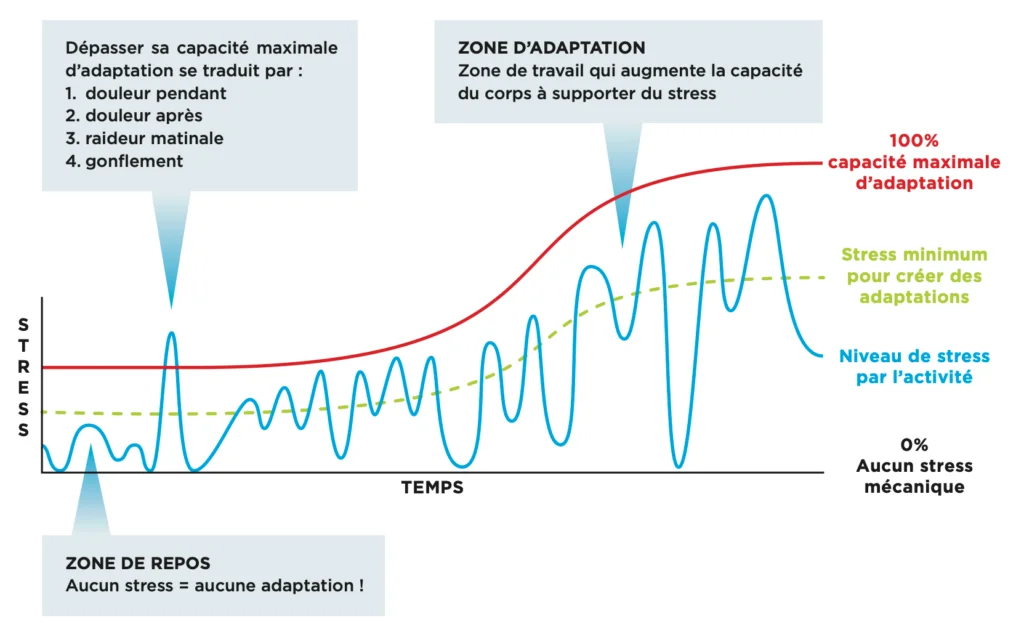
Quantifying mechanical stress is not based solely on a single session but on the accumulation of load over time. [5–7,12] It is the balance between the acute (recent) load and the chronic (usual) load that determines injury risk.
The body tolerates stress well when it increases gradually, respecting the adaptive capacity of the tissues. [5–7]
Tolerance to mechanical stress varies with the runner’s experience, fitness level and history. What suits one runner may be excessive for another. [12]
Tissues get stronger during rest phases. Without adequate recovery, the load accumulates without adaptations being able to take place. [5,6]
A sudden increase in load, lack of recovery or the combination of several stress factors can exceed the adaptive capacity of the tissues and significantly increase the risk of injury. [5–7,12]
❓ Frequently asked questions
How do I know if I’m running too much?
The warning signs of mechanical overload vary: persistent pain after exercise, heavy legs, a drop in performance for no apparent reason, or localised pain that increases with effort. If these signs appear, it is advisable to reduce the load and see a health professional.
Should I count my kilometres to manage mechanical stress?
Volume in kilometres is a useful indicator but insufficient on its own. You also need to consider intensity (easy vs intense sessions), elevation, terrain and level of recovery. A detailed training log or a GPS watch can help objectify this data. [5–7]
Can stride cadence really reduce the risk of injury?
Studies show that slightly increasing cadence (by 5 to 10%) reduces certain biomechanical parameters associated with injury, such as vertical oscillation and braking force. [9] However, it is not a universal solution, and any technical change must be gradual and supervised.
Does strength training help manage mechanical stress?
Yes. Targeted strength training improves the ability to absorb impacts, joint stability and the management of asymmetries. It is one of the pillars of injury prevention in runners and helps increase tolerance to mechanical loads. [4,5]
✅ Key takeaways
10 km = ~10,000 impacts per leg. Progression must be measured and respect the tissues’ capacity to adapt.
Intense sessions are necessary but must be dosed in relation to total volume and available recovery.
There is no universal technique: a personalised biomechanical analysis remains the best tool to optimise the management of mechanical load.
Maintaining a balanced acute:chronic load ratio is the key to lasting, injury-free progress. [6,7]
Conclusion
Balance between stress and adaptation
Quantifying and managing mechanical stress helps prevent injury, improve progress and optimise recovery. The goal is to maintain a lasting balance between the stresses imposed on the body and its capacity to adapt. [4,5]
- van Gent RN, et al. Incidence and determinants of lower extremity running injuries. Br J Sports Med. 2007.
- Nielsen RO, et al. Training errors and running injuries. Int J Sports Phys Ther. 2012.
- Buist I, et al. Training-related risk factors for running injuries. Am J Sports Med. 2008.
- Bertelsen ML, et al. Framework for understanding running injuries. Br J Sports Med. 2017.
- Gabbett TJ. The training-injury prevention paradox. Br J Sports Med. 2016.
- Hulin BT, et al. Acute:chronic workload ratio and injury risk. Br J Sports Med. 2016.
- Malone S, et al. Workload spikes and injury risk. Br J Sports Med. 2017.
- Novacheck TF. The biomechanics of running. Gait Posture. 1998.
- Heiderscheit BC, et al. Step rate manipulation and running mechanics. Med Sci Sports Exerc. 2011.
- Milner CE, et al. Biomechanics of running and injury risk. J Orthop Sports Phys Ther. 2006.
- Zadpoor AA, Nikooyan AA. The relationship between impact forces and injuries. J Biomech. 2011.
- Edwards WB. Modeling overuse injuries in sport. Exerc Sport Sci Rev. 2018.