
Definition
Patellar tendinopathy, often called “patellar tendinitis”, is a painful condition of the patellar tendon, most often located at its origin, at the inferior pole of the patella (kneecap). It is particularly common in sports involving repeated jumps, accelerations, decelerations, changes of direction, landings and explosive movements, which has earned it the nickname “Jumper’s knee”.
The term tendinopathy is now preferred to “tendinitis”. In chronic forms, the changes observed within the tendon correspond more to remodelling and alteration of the tendon structure (collagen disorganisation, changes in the extracellular matrix, cellular and vascular changes) than to simple inflammation. This is why purely anti-inflammatory treatments are not the core treatment: the main goal is to restore the mechanical capacity of the tendon.
Anatomy
The patellar tendon connects the patella to the tibial tuberosity. Together with the quadriceps, the patella and the quadriceps tendon, it forms the knee extensor mechanism. This tendon, which is usually a few centimetres long, is subjected to considerable stresses during explosive activities. Its proximal part, at the inferior pole of the patella, is the most common site of tendinopathy.
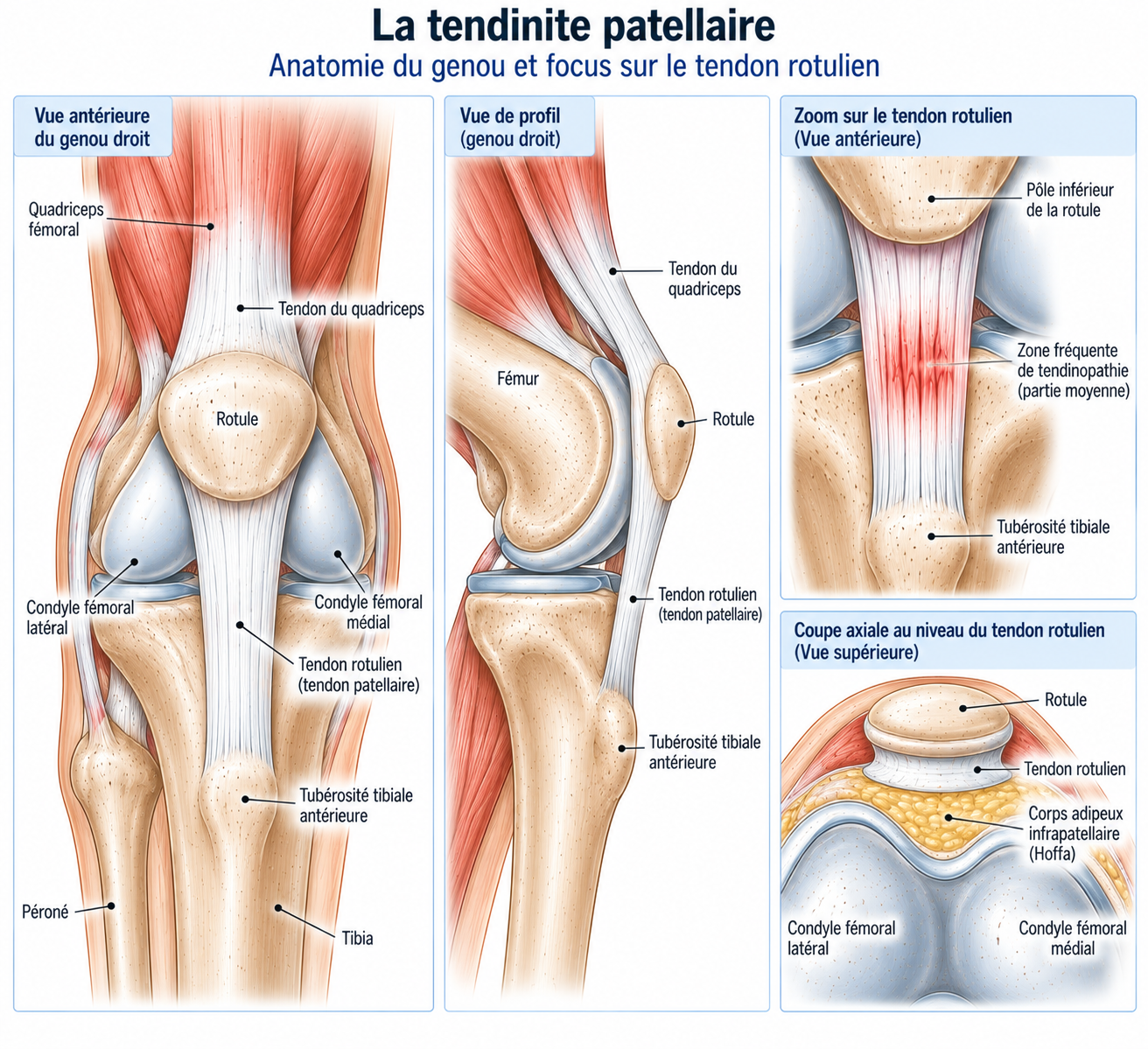
🔍 Click on the image to enlarge it
Function and biomechanics
The patellar tendon transmits the force generated by the quadriceps to the tibia (quadriceps → patella → patellar tendon → tibia). It thus enables knee extension, acceleration, jumping, landing, braking and changes of direction. It also acts as a structure capable of storing and then releasing elastic energy, a function that is particularly important in explosive movements.
During a jump, the force transmitted can be considerable; on landing, the tendon must absorb part of the mechanical energy before helping to release it during the next jump or acceleration. It is this capacity to store → release → repeat that explains why sports involving many jumps are particularly exposed to this condition.
Epidemiology
Patellar tendinopathy is particularly common in jumping and pivoting sports: volleyball, basketball, handball, football, athletics. It can also affect runners, CrossFit athletes, weightlifters, people who do strength training and athletes who perform heavy squats.
A recent meta-analysis estimates its prevalence at around 18% in the athletic populations studied, with particularly high rates in jumping sports.
Causes & risk factors
The tendon normally adapts to the stresses placed on it: when load increases gradually, its capacity increases accordingly (load → adaptation → increased tendon capacity). But if load increases too quickly relative to the tendon’s capacity to adapt, overload sets in and symptoms appear. This typically happens when there is a sudden increase in the number of jumps, intensity, training frequency, strength work, sprint volume or specific training.
Training-related factors
Sudden increase in training volume, increase in the number of jumps, return after a break, change of programme, increase in explosive sessions, sprint work or heavy squats.
Muscular factors
Quadriceps strength deficit, lower limb capacity deficit, muscle fatigue, posterior chain strength or endurance deficit.
Individual factors
Age, level of sport, history of tendinopathy, body composition, metabolic factors, certain medications. However, these individual factors should not be considered as sole causes.
The classic scenario
An athlete suddenly increases their training — for example, returning to basketball combined with more training sessions and extra jumping sessions. They then experience a typical progression: pain after training → pain during jumps → pain on stairs or when squatting. Gradually, the tendon becomes painful under lower and lower loads.
Symptoms
The pain is usually anterior, very localised and situated at the inferior pole of the patella: the patient often points precisely to the painful area with one finger, and this very precise location is characteristic. In some forms, the pain may also be felt lower down the tendon.
The mechanical nature of the pain is key: it appears during activities that place heavy demands on the extensor mechanism (jumping, landing, sprinting, squatting, lunging, climbing stairs, fast running) and may also be felt after training. In more advanced forms, pain may occur when walking, when squatting, or even at rest.
Jumping is particularly useful for assessing the tendinopathy (vertical jump, single-leg jump, horizontal jump, countermovement jump): the clinician looks for pain, loss of power, asymmetry or apprehension. Reduced jumping performance can be a useful functional indicator.
Clinical examination
On palpation, there is localised pain at the inferior pole of the patella, at the origin of the patellar tendon. On contraction, pain is sought during resisted extension, a squat or a jump. On stretching, deep knee flexion can reproduce the pain by putting the extensor mechanism under tension.
The squat test assesses pain, strength, knee control, tolerated depth and movement quality; the load can be increased gradually, as a deep squat considerably increases the load on the tendon. The single-leg decline squat is classically used in the assessment and monitoring of patellar tendinopathy: it reproduces the pain, assesses load tolerance and allows progress to be tracked, but it places a high load on the tendon and should therefore be used with caution in very irritable forms — recent biomechanical studies show that it is among the exercises that place the highest loads on the patellar tendon.
It is also useful to assess the strength of the quadriceps, hamstrings, triceps surae and hip muscles (dynamometer, isokinetic testing, functional tests, force platform), ideally comparing the painful side with the healthy side, and the current level with the athlete’s usual level.
Further tests
Ultrasound
May show tendon thickening, fibre disorganisation, hypoechoic areas, hypervascularity, a tear or a rupture. Allows dynamic examination of the tendon and monitoring of its structural changes. Note: a tendon with ultrasound abnormalities can be completely asymptomatic — imaging should never be interpreted in isolation.
MRI
Used to study tendon structure, look for a tear, oedema, involvement of the patella or patellofemoral structures, and rule out other differential diagnoses. Particularly useful in cases of atypical pain, prolonged treatment failure, suspected rupture or before possible surgery.
Differential diagnoses
Patellofemoral pain syndrome
More diffuse pain, around or behind the kneecap, often triggered by stairs, squatting or prolonged sitting — less precisely localised to the tendon than patellar tendinopathy.
Infrapatellar bursitis
More superficial pain, which may be aggravated by kneeling or direct pressure.
Hoffa's disease
More diffuse anterior pain, sometimes aggravated by knee hyperextension.
Quadriceps tendinopathy
Pain located at the superior pole of the patella, not the inferior pole.
Meniscal tear
More joint-related pain, sometimes accompanied by catching, locking or pain on rotation.
Cartilage injury (patellofemoral chondropathy)
May cause anterior pain but must be distinguished from tendinopathy.
Sinding-Larsen-Johansson syndrome
In adolescents: pain at the inferior pole of the patella, at a growth centre that is still active.
Osgood-Schlatter disease
In adolescents: pain localised to the tibial tuberosity rather than the patella.
Patellar tendon rupture (partial or complete)
Sudden pain, a snapping sensation, loss of extension strength and difficulty lifting the straight leg — an orthopaedic emergency, not to be confused with chronic tendinopathy.
Classification
Stage 1
Pain only after sporting activity, with no effect on performance.
Stage 2
Pain during activity, but not yet significantly limiting sporting performance.
Stage 3
Pain during and after activity, with reduced sporting performance.
Stage 4
Patellar tendon rupture: orthopaedic emergency.
Treatment
Core principle: load management and progressive exercise
Treatment is based on load management, progressive exercise and restoring tendon capacity — so it is not simply a matter of "resting the tendon", but of gradually reloading it. The first step is to identify the activities that impose the most load (jumping, sprinting, changes of direction, heavy squats, plyometrics) and to temporarily reduce their frequency, volume or intensity, without it being necessary to stop all activity.
In many cases, sport can be continued: controlled pain during exercise is acceptable if it remains stable, does not gradually worsen and does not cause significant compensation, if the tendon returns to its usual level after exertion and if there is no significant worsening the next day. Monitoring the response to load is therefore more relevant than an absolute rule such as "no pain = no risk".
Phase 1 — Isometrics (reducing pain)
When the tendon is very irritable, treatment starts with isometric exercises (for example, resisted knee extension without movement, performed in 4 to 5 sets of 30 to 45 seconds). The aim is to temporarily reduce pain, maintain quadriceps activation and prepare the tendon for the loading to come. These exercises are particularly useful for short-term pain management, especially in athletes who need to keep training.
Phase 2-3 — Quadriceps reconditioning and heavy slow resistance training
Once irritability is under control, the load is increased gradually: squats, leg press, knee extensions, split squats, lunges, with the aim of progressively increasing the tendon's strength, capacity, endurance and load tolerance.
Heavy slow resistance training, combining progressive load, controlled movement, moderate volume and sufficient recovery, is a particularly useful approach at this stage. Comparative data suggest that it may be particularly useful for achieving lasting improvements in tendon function and capacity.
Phase 4 — Eccentric work
Eccentric work involves loading the tendon during the muscle-lengthening phase (slow lowering in a squat, decline squat, controlled single-leg work). For a long time it was one of the main treatment strategies and it remains effective, but it should not necessarily be considered superior to all other forms of loading: what matters most is load progression and consistent work.
Phase 5-6 — Single-leg work, then energy storage and release
The next step is single-leg work (single-leg squat, split squat, step-down, lunge, single-leg decline squat), which gradually brings rehabilitation closer to the demands of sport.
However, patellar tendinopathy in a jumping athlete cannot be rehabilitated with slow exercises alone: the tendon must ultimately regain its capacity to absorb, store and then rapidly release energy. Small jumps, skipping rope, pogo jumps, vertical jumps, bounds and horizontal jumps are therefore gradually introduced.
Phase 7 — Plyometrics, full kinetic chain and return to sport
The plyometric progression can follow this order: two-leg jumps → single-leg jumps → multidirectional jumps → landings → rapid sequences, then sprinting, changes of direction, braking and sport-specific movements. The aim is to rebuild the tendon's capacity to withstand fast loads, which are often those of sport — plyometrics is in fact often introduced too late, even though the patellar tendon is specifically specialised in fast activities; it must nevertheless be introduced gradually when the tendon is still very irritable.
The patellar tendon does not work in isolation: the hip (gluteus medius and maximus, abductors), trunk (lumbopelvic control), ankle (triceps surae, mobility, foot control) and hamstrings (strength, absorption capacity) must also be worked on, in order to restore the capacity of the whole lower limb. In runners, the return to running can follow a progression such as easy running → duration → volume → accelerations → hills → interval training, with each step validated by the tendon's response.
Complementary treatments
Taping / strapping
May sometimes temporarily reduce pain, particularly during a session or when returning to sport. It is not a core treatment.
Knee brace (infrapatellar strap)
May sometimes alter symptoms in some athletes, during activity or when returning to sport. It does not restore tendon capacity.
Manual therapy
Can be used as an adjunct to improve mobility, temporarily reduce pain or make certain exercises easier, but should not replace progressive loading: passive treatments alone are insufficient to restore tendon capacity.
Shockwave therapy
Studied in chronic patellar tendinopathy, with variable results. May be considered as an adjunct in some resistant forms, but do not replace the strengthening programme.
Laser, ultrasound and other physical therapies
These are not the core of management, which remains appropriate loading and progressive exercise.
Corticosteroid injection
May reduce pain in the short term, but is not a core treatment for patellar tendinopathy. The risk of tendon weakening and recurrence must be taken into account; the disappearance of pain after an injection does not mean that the tendon has regained its mechanical capacity.
PRP (platelet-rich plasma)
Used in some chronic patellar tendinopathies, but with heterogeneous results. It should not be offered routinely as a first-line treatment; it may be discussed in some chronic forms after properly conducted active management, while explaining the uncertainty of the level of evidence.
Surgery
Surgery is generally reserved for chronic, disabling forms that are resistant to well-conducted rehabilitation or associated with significant structural damage. It may involve debridement, excision of the pathological tissue or repair, using open or arthroscopic techniques.
A systematic review published in 2025 on surgery for refractory patellar tendinopathy reports a significant improvement in functional scores and an average return-to-sport rate of around 87%, while highlighting the considerable heterogeneity of the available studies and the lack of high-quality trials.
A patellar tendon rupture (in a healthy tendon after violent trauma, or in an already weakened tendon) is a different condition, causing sudden pain, a snapping sensation, loss of extension strength and difficulty lifting the straight leg: it is an orthopaedic emergency. A partial rupture can be more difficult to diagnose; treatment strategies are then very heterogeneous and depend in particular on the extent of the injury and the level of sport.
Recovery time
Improvement can be achieved within a few weeks, but full recovery often takes several months; chronic forms may require long, progressive rehabilitation. Return to sport should not be based solely on the number of weeks elapsed, but on several criteria: low, stable pain with no worsening the next day; satisfactory recovery of quadriceps strength with good symmetry and sufficient endurance; the ability to perform a single-leg squat, a lunge, a jump, a landing or changes of direction; and, depending on the sport, appropriate performance (jump height, power, speed, acceleration, repeated jumps).
The VISA-P (Victorian Institute of Sport Assessment – Patella) is a questionnaire specifically developed to assess the severity of patellar tendinopathy, covering pain, function and sporting capacity, with a score ranging from 0 (very poor functional status) to 100 (no significant limitation). It is particularly useful for tracking progress during rehabilitation.
After surgery, rehabilitation is progressive: protecting the repair and controlling oedema, then muscle recovery (quadriceps, hamstrings, hip, calf), strengthening (squats, leg press, single-leg work, progressive loads), impact work (jumps, landings, bounds) and finally return to sport (sprinting, changes of direction, sport-specific jumps, technical skills). The timeline depends heavily on the surgical procedure performed.
Prevention
Prevention is mainly based on load progression, maintaining strength, sufficient recovery, varying intensities and monitoring symptoms. In jumping athletes, the capacity to absorb jumps must be trained as much as the capacity to jump: a sudden return to high plyometric volume after a period without jumping is indeed a classic overload scenario.
Frequently asked questions
Is it really a tendinopathy?
Is it the same as patellofemoral pain syndrome?
Can I keep playing sport?
Should I stop jumping?
Is squatting bad for the tendon?
Are deep squats dangerous?
Does rest cure tendinopathy?
Are eccentric exercises essential?
How long does it take to heal?
Can I have tendinopathy with a normal MRI?
Does a very abnormal MRI mean I need surgery?
Common mistakes
Complete rest for several weeks, which reduces tendon capacity.
Going straight back to jumping without progressive reconditioning of the tendon.
Relying only on stretching, which does not rebuild the tendon's mechanical capacity.
Doing only eccentric work and neglecting other forms of loading (isometric, heavy slow resistance, plyometrics).
Working only on the quadriceps, without rehabilitating the whole lower limb chain.
Relying solely on MRI, even though tendon structure does not always match the symptoms.
Using an injection as a definitive treatment, even though it may reduce pain without restoring tendon capacity.
Returning to sport as soon as the pain disappears, even though this does not mean that the tendon's capacity has returned to its previous level.
Key points — Institut Basque du Coureur
Patellar tendinopathy, or "patellar tendinitis", is a common condition in athletes involved in explosive activities. It is typically characterised by very localised, load-related pain at the inferior pole of the patella, occurring during jumps, squats, accelerations or landings, with a gradual decline in sporting capacity as the condition progresses. Treatment is based above all on load management, progressive strengthening, restoring tendon capacity and reintroducing fast loads: isometrics can be useful to control pain early on, heavy slow resistance and eccentric work then increase tendon capacity, and plyometrics and sport-specific exercises are essential before a full return in jumping athletes. A patellar tendon must not simply become pain-free again: it must once again be able to withstand the loads that the sport will actually place on it — the disappearance of pain is therefore a milestone, not the end of rehabilitation.
- Malliaras P, Cook J, Purdam C, Rio E. Patellar Tendinopathy: Clinical Diagnosis, Load Management, and Advice for Challenging Case Presentations. J Orthop Sports Phys Ther. 2015;45(11):887-898.
- Breda SJ, Oei EHG, Zwerver J, et al. Effectiveness of progressive tendon-loading exercise therapy in patients with patellar tendinopathy: a randomised clinical trial. Br J Sports Med.
- Lim HY, Wong SH. Effects of isometric, eccentric, or heavy slow resistance exercises on pain and function in individuals with patellar tendinopathy: a systematic review. Phys Ther Sport. 2018.
- Núñez-Martínez P, et al. Management of Patellar Tendinopathy Through Monitoring, Load Control, and Therapeutic Exercise: A Systematic Review. J Sport Rehabil. 2022.
- Li Y, Sun D, Fang Y, et al. Mixed comparison of intervention with eccentric, isometric, and heavy slow resistance for VISA-P in adults with patellar tendinopathy: a systematic review and network meta-analysis. Heliyon. 2024;10:e39171.
- Rio E, Kidgell D, Purdam C, et al. Isometric exercise induces analgesia and reduces inhibition in patellar tendinopathy. Br J Sports Med.
- van Ark M, Cook JL, Docking SI, et al. Do isometric and isotonic exercise programs reduce pain in athletes with patellar tendinopathy in-season? Clin J Sport Med.
- Sprague A, Smith AH, Knox P, Pohlig R, Silbernagel KG. Modifiable risk factors for patellar tendinopathy in athletes: a systematic review. Br J Sports Med.
- Rees JD, Stride M, Scott A. Tendons – time to revisit inflammation. Br J Sports Med.
- Scott A, Backman C, Speed C. Tendinopathy: Update on Pathophysiology. J Orthop Sports Phys Ther.
- Rudavsky A, Cook J. Physiotherapy management of patellar tendinopathy (jumper's knee). J Physiother.
- Epidemiology of Patellar Tendinopathy in Athletes and the General Population: A Systematic Review and Meta-analysis. Am J Sports Med. 2023.
- Partial Patellar Tendon Tears in Athletes: A Systematic Review of Treatment Options, Outcomes, and Return to Sport. 2024.
- A Systematic Review of Surgical Treatment for Refractory Patellar Tendinopathy. J Am Acad Orthop Surg. 2025.
- Patellar Tendon Load Progression during Rehabilitation Exercises: Implications for the Treatment of Patellar Tendon Injuries. 2023.
- Clinical Management of Patellar Tendinopathy. J Athl Train. 2022.
Similar injuries
Pes anserinus tendinopathy
Inflammation of the tendons that insert on the inner side of the tibia (sartorius, gracilis, semitendinosus), causing pain on the inner side of the knee.
Quadriceps tendinopathy
Inflammation of the quadriceps tendon above the kneecap, a common overuse injury when training is increased too quickly.
Patellofemoral pain syndrome
Anterior knee pain caused by poor patellar tracking, accounting for 25 to 40% of knee injuries in runners.