
Definition
Quadriceps tendinopathy is a painful condition of the quadriceps tendon, which lies above the kneecap and helps transmit the force of the quadriceps to the patella and then to the patellar tendon. It mainly presents as anterior knee pain, located above the kneecap, at the insertion of the quadriceps tendon on the upper pole of the patella, and usually occurs in a context of repeated overload of the knee extensor mechanism.
It is particularly common in athletes whose sport involves jumping, running, accelerations, changes of direction or squats. Jumping sports such as basketball, volleyball and some racket sports are particularly affected.
The term “quadriceps tendinitis” is commonly used, but quadriceps tendinopathy is more appropriate in chronic forms: the issue is less an acute inflammation than a change in the tendon’s capacity to withstand the stresses placed on it.
Anatomy
The quadriceps is made up of four muscles — the rectus femoris, the vastus medialis, the vastus lateralis and the vastus intermedius — which converge into the quadriceps tendon. This tendon inserts mainly on the upper border of the patella and forms part of the continuous extensor mechanism: quadriceps → quadriceps tendon → patella → patellar tendon → tibial tuberosity. This continuity allows the force produced by the quadriceps to be transmitted to the tibia.
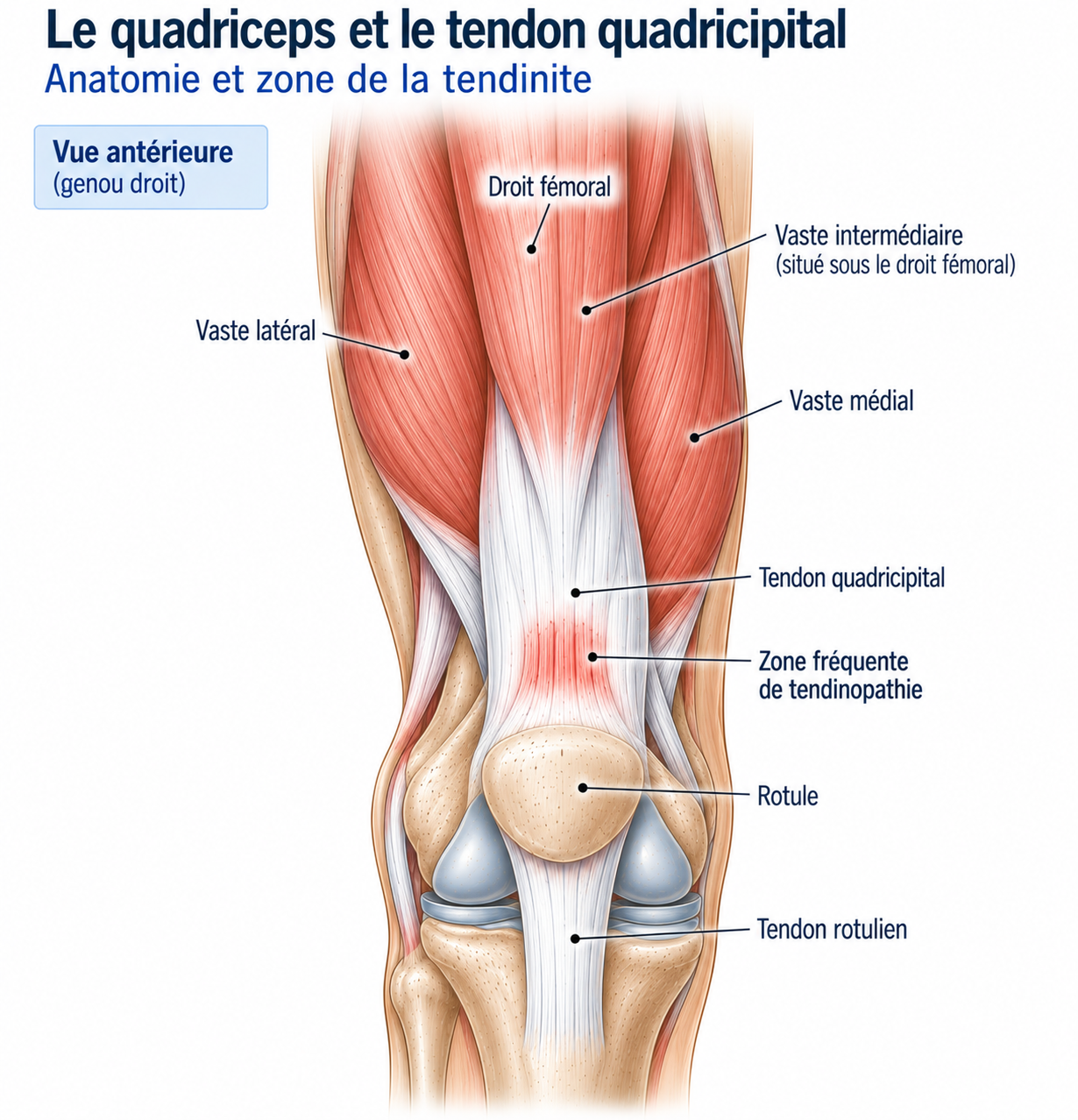
🔍 Click on the image to enlarge it
Function of the quadriceps tendon
The main function of the quadriceps tendon is to transmit the force of the quadriceps to allow knee extension, propulsion, jumping, running, climbing stairs, braking when landing from a jump and controlling knee flexion. The quadriceps is therefore not only used to “straighten the leg”: it also plays a major role in the eccentric control of the knee.
Quadriceps tendon and patellar tendon: what is the difference?
These two tendons belong to the same extensor mechanism but are not identical: in quadriceps tendinopathy, the pain is mainly located above the kneecap, whereas in patellar tendinopathy it is mainly located below the kneecap, most often at the lower pole of the patella or in the patellar tendon. This distinction is important because the two conditions can cause very similar anterior knee pain.
Biomechanics
The quadriceps tendon is subjected to particularly high stresses when the quadriceps has to produce or control a high force: jumps, landings, accelerations, decelerations, changes of direction, heavy squats, uphill and downhill running, fast running. During a jump, the quadriceps must produce a large force to propel the body; on landing, by contrast, it must actively brake knee flexion. The tendon must therefore be able to both produce and absorb large forces.
The main mechanism of pain is generally an imbalance between the load applied to the tendon and its capacity to withstand it. A healthy tendon can withstand very high loads, but its capacity to adapt is not instantaneous: a sudden increase in load can exceed it — for example, an athlete who is not usually exposed to jumping and abruptly takes up basketball, volleyball, tennis, heavy squats or interval training again.
The term “tendinitis” suggests inflammation, but in chronic forms the reality is more complex: tendinopathy corresponds to a set of structural, cellular, mechanical and biochemical changes. Acute inflammation may play a part in certain phases, but it does not on its own explain chronic symptoms — treatment therefore does not simply consist of “removing the inflammation”, but above all of restoring the tendon’s mechanical capacity.
Epidemiology
Quadriceps tendinopathy is particularly common in athletes whose sport involves jumping, running, accelerations, changes of direction or heavy squats. Jumping sports such as basketball, volleyball and some racket sports are particularly affected, as are people who do strength training involving heavy squats or plyometric work introduced too abruptly.
A particularly high-risk situation is returning to a jumping sport after several months without practice (for example, little sport over the summer followed by an abrupt return to basketball): the tendon has not necessarily lost all its capacity, but it is no longer prepared for this specific load.
Causes & risk factors
Quadriceps tendinopathy usually develops when there is an imbalance between the load applied to the tendon and its capacity to withstand it. Several factors can contribute to its onset.
Load-related factors
A sudden increase in training volume or intensity, a return to sport after a break, more frequent jumping sessions, more strength training sessions or heavier squat loads, and the abrupt introduction of plyometric work are the main load factors.
Biomechanical factors
A lack of strength in the quadriceps or hip muscles, poor lower limb control, poor tolerance of eccentric loads or a marked increase in the stresses on the extensor mechanism also contribute to the onset of symptoms.
Individual factors
Certain general factors can also alter the tendon’s capacity to adapt; however, they should be regarded as contextual factors rather than as a single cause.
Symptoms
The classic picture is that of an athlete describing pain just above the kneecap when jumping or squatting. At first, the pain may appear only after training, after a jumping or strength session, and then it may gradually appear during squats, jumps, running, on stairs or during everyday activities.
The main symptom is anterior knee pain, usually well localised at the upper pole of the patella, at the insertion of the quadriceps tendon — the patient can often point precisely to the painful area with one finger. Typically painful activities are jumping, landing, squatting, climbing stairs, running, accelerating and decelerating. A feeling of stiffness may be present at the start of activity, after a period of inactivity, or the day after a demanding session.
Jump-related pain may appear on take-off, on landing or during repeated jumps — particularly important information for athletes in jumping sports. During a squat, the pain may be absent at small angles, present when the knee bends further, and greater with additional load: this gradation helps assess the tendon’s capacity to withstand different loads.
Clinical examination
The examination looks at the precise location of the pain, tenderness on palpation, pain on quadriceps contraction, during squats or single-leg exercises, quadriceps strength, lower limb control, hip and ankle mobility, and any signs of patellar or intra-articular pathology. The diagnosis is mainly clinical.
Palpation looks for pain specifically at the upper pole of the patella, over the insertion of the quadriceps tendon — pain reproduced precisely at this site is an important finding, which should always be weighed against the other clinical findings. A resisted contraction of the quadriceps (knee extension, isometric contraction) may reproduce the pain; pain localised to the tendon strengthens the diagnostic hypothesis.
The squat is a particularly useful functional test: it shows when the pain appears, the depth at which it occurs, movement quality, symmetry, knee control and tolerance to repetition — it can also be used to monitor progress during rehabilitation. The single-leg squat assesses quadriceps strength, knee stability, pelvic control and lower limb coordination, in conditions closer to the demands of sport.
Further tests
Ultrasound
May show thickening of the tendon, a change in echotexture, hypoechoic areas, hypervascularisation, partial tears or insertional abnormalities. Also allows dynamic assessment.
MRI
May show tendon thickening, signal abnormalities, oedema, involvement of the insertion, fissuring or a partial/complete tear. Useful if another condition is suspected or if a tear needs to be characterised precisely.
Differential diagnoses
Patellar tendinopathy
The pain is usually below the kneecap, not above it.
Patellofemoral pain syndrome
The pain is often more diffuse, around or behind the patella.
Prepatellar bursitis
More superficial pain, which may be accompanied by local swelling.
Patellofemoral osteoarthritis
May cause pain and crepitus, rather than pain specifically localised to the tendon.
Meniscal tear
To be considered in the event of joint pain, locking or mechanical symptoms.
Quadriceps muscle injury
Usually more proximal, in the muscle itself, often appearing after a sudden movement.
Quadriceps tendon rupture
To be ruled out in the event of sudden trauma with loss of strength and difficulty actively extending the knee — a relative orthopaedic emergency.
Classification
Stage 1
Pain only after activity.
Stage 2
Pain during activity but still allowing sport to be practised.
Stage 3
Pain progressively limiting training.
Stage 4
Pain present during everyday activities, or suspicion of a significant structural lesion.
Treatment
Phase 1 — Reducing irritability
The aim is to reduce pain, stay active and begin loading the tendon, without complete rest. It is often possible to continue sport by adapting it: fewer jumps, shallower squats, lighter loads, temporarily dropping plyometric sessions, and keeping up cycling or swimming if well tolerated. You can start with isometric quadriceps exercises: knee extension against a fixed resistance, 30 to 45 seconds, 4 to 5 repetitions, 1 to 2 minutes' recovery, with intensity adapted to tolerance. These isometric exercises allow a gradual return to loading but do not on their own constitute complete rehabilitation.
Phase 2 — Dynamic strengthening
As tolerance improves, knee extension, partial squats, leg press, step-ups and single-leg press are gradually introduced, in order to progressively restore the quadriceps' capacity to produce force.
Phase 3 — Heavy resistance and eccentric work
Resistance is gradually increased: squat (3-4 × 6-10), leg press (3-4 × 6-10), knee extension (3-4 × 8-12), split squat (3 × 8-10). The tendon must gradually be exposed to loads high enough to stimulate its adaptation. Eccentric work can be included (slow squat, 3 to 5-second squat descent, step-down, split squat with slow descent) to teach the quadriceps to gradually control knee flexion under load, without regarding it as necessarily superior to other forms of strengthening.
Phase 4 — Unilateral strengthening
Sport often involves asymmetric stresses. Single-leg squats, split squats, step-downs, single-leg press, lunges and step-ups onto a bench are gradually introduced, in order to improve knee strength and control, correct any asymmetries and prepare for the stresses of sport.
Phase 5 — Full range of motion and power
Range of motion is gradually increased (partial → intermediate → deep squat; the same principle applies to the leg press, lunges and split squats), in order to prepare the tendon for the ranges actually used in sport. Once strength has been restored, rate of force development is gradually trained: fast step-ups, dynamic squats, vertical and horizontal jumps, bounds. This stage marks the transition from strength rehabilitation to sport-specific preparation.
Phase 6 — Plyometrics and sport-specific return
Plyometrics are introduced gradually: small jumps on the spot, vertical jumps, single-leg jumps, horizontal jumps, repeated jumps, then sport-specific jumps — volume is increased gradually. For a runner, the reintroduction follows this sequence: brisk walking, slow jogging, continuous running, increased volume, accelerations, interval training, hills, then a return to specific sessions. For an athlete in a jumping sport, vertical and horizontal jumps, landing, blocking, rebounding, changes of direction and repeated jumps must be gradually reintroduced: the tendon must regain the capacity to produce and absorb high forces rapidly. Increasing volume and intensity at the same time should be avoided.
Complementary treatments
Taping
May temporarily change pain perception, the athlete's confidence or tolerance of certain exercises, but is not a curative treatment.
Knee brace / strap
May sometimes improve comfort, but no device has sufficiently proven efficacy to make it a standard treatment — it remains a possible adjunct.
Massage and manual therapy
May temporarily reduce pain, reduce the feeling of muscle tension and make certain exercises easier, but does not replace strengthening.
Extracorporeal shockwave therapy
May be considered in certain resistant chronic forms, but data specifically on the quadriceps tendon remain limited.
Laser, ultrasound and other passive treatments
May sometimes have a symptomatic effect, but the evidence is considerably weaker than for active management through exercise and load management.
Anti-inflammatories (NSAIDs)
May sometimes temporarily reduce pain but do not correct the underlying mechanical problem; they are not the main treatment for chronic tendinopathy.
Corticosteroid injections
To be used with caution around a tendon: a rapid reduction in pain can give the impression that the tendon has healed when its mechanical capacity has not been restored. Not a first-line treatment.
PRP (platelet-rich plasma)
Data specific to the quadriceps tendon remain insufficient to recommend its routine use; it may possibly be considered on a case-by-case basis after a well-conducted active management programme has failed.
Surgery
Surgery is rarely necessary in uncomplicated quadriceps tendinopathy. It may be considered in cases of very disabling chronic tendinopathy, prolonged failure of well-conducted rehabilitation, a significant partial tear or major functional loss; data on surgery for chronic tendinopathy remain limited and indications must be individualised.
The situation is different in the case of a quadriceps tendon rupture, an acute condition very different from simple tendinopathy. It usually occurs suddenly, combining a strong contraction of the quadriceps with sudden flexion of the knee, with a snapping sound, sudden pain, a tearing sensation, swelling and a significant loss of strength. The main functional sign is difficulty or inability to actively extend the knee (difficulty lifting the straight leg, walking or climbing stairs), sometimes with a palpable gap above the kneecap. A complete rupture is a relative orthopaedic emergency and must be diagnosed quickly; MRI makes it possible to determine whether it is complete or partial, its location, the degree of retraction and any associated injuries.
A complete rupture is generally treated surgically, in order to restore the continuity of the extensor mechanism, active extension, quadriceps strength and knee function. Post-operative rehabilitation is then progressive and much longer than for simple tendinopathy: protection of the repair, gradual recovery of mobility, reactivation of the quadriceps, progressive strengthening, functional work, running, jumping and plyometrics, then a sport-specific return — a progression guided by functional criteria rather than by time elapsed alone.
Recovery time
Recovery time depends heavily on how long the symptoms have been present and how severe they are, the sports load, the tendon’s capacity to be reloaded and the possible presence of a structural lesion. A mild form may improve within a few weeks, whereas chronic tendinopathy may require several months of rehabilitation. Avoid considering the tendon “healed” simply because the pain has disappeared after a few days: its mechanical capacity must be rebuilt gradually.
Prevention
Prevention mainly relies on the extensor mechanism having a good capacity to withstand sporting loads: regular quadriceps strengthening, unilateral work, work on the glutes, hamstrings and calves, power exercises and plyometric exercises.
It also involves a reasonable progression in jumping and training volume, avoiding abrupt returns to a jumping sport after a prolonged period of inactivity.
Frequently asked questions
Can you run with quadriceps tendinopathy?
Can you continue strength training?
Should you stop doing squats?
Are jumps off limits?
Is stretching necessary?
Is an MRI mandatory?
Can quadriceps tendinopathy turn into a rupture?
Is PRP effective?
When should you see a doctor?
Common mistakes
Complete rest: reduces symptoms but also reduces the tendon's capacity.
Going straight back to jumping: the tendon may tolerate a squat but not yet 100 jumps.
Doing only stretching, which does not replace strengthening.
Favouring passive treatments (massage, taping, physiotherapy modalities) without combining them with exercise.
Increasing volume and intensity at the same time — a common cause of recurrence.
Relying solely on pain, which on its own is not a perfect measure of the tendon's capacity.
Neglecting power: a tendon may be strong enough for a heavy squat but insufficiently prepared to absorb repeated jumps.
Key points — Institut Basque du Coureur
Quadriceps tendinopathy is pain in the tendon located above the kneecap, generally linked to progressive overload of the extensor mechanism. It is particularly common in sports involving jumping, accelerations, decelerations, changes of direction and heavy quadriceps work. Diagnosis is mainly clinical; imaging is reserved for situations where it provides additional information. Treatment is based above all on load management, progressive strengthening, unilateral work, power, plyometrics and a gradual return to sport, successively restoring strength, the capacity to absorb load, power, speed, repetition and then sport-specific movements. A quadriceps tendon is not truly ready for sport simply because it no longer hurts: it must once again be able to withstand the stresses that the sport will place on it.
- King D, Yakubek G, Chughtai M, Khlopas A, Saluan P, Mont MA, Genin J. Quadriceps tendinopathy: a review — part 1: epidemiology and diagnosis. Ann Transl Med. 2019;7(4):71.
- Chughtai M, Yakubek G, Newman JM, et al. Quadriceps tendinopathy: a review, part 2 — classification, prognosis, and treatment. Ann Transl Med. 2019.
- McCreesh K, Lewis J. Continuum model of tendon pathology: what is new? Br J Sports Med.
- Malliaras P, Cook J, Purdam C, Rio E. Patellar Tendinopathy: Clinical Diagnosis, Load Management, and Advice for Challenging Case Presentations. J Orthop Sports Phys Ther. 2015;45(11):887-898.
- McAuliffe S, McCreesh K, Purtill H, O'Sullivan K. A systematic review of the effectiveness of exercise interventions for tendinopathy.
- Pavlova AV, et al. Effect of resistance exercise dose components for tendinopathy management: a systematic review with meta-analysis. Br J Sports Med. 2023.
- Load progression criteria in exercise programmes in lower limb tendinopathy: a systematic review. BMJ Open. 2021.
- Knee Extensor Mechanism Tendinopathy: Evaluation, Treatment, and Prevention. Sports Med Arthrosc Rev. 2022.
- Trybulski R, Olaniszyn G, Matuszczyk F, et al. Eccentric Training for Tendinopathies in Athletes: A Scoping Review and Evidence Gap Map. J Sports Sci Med. 2026.
- Acute Quadriceps Tendon Rupture: Presentation, Diagnosis, and Management. JBJS Rev. 2022.
Similar injuries
Knee osteoarthritis
Osteoarthritis of the knee characterised by progressive wear of the cartilage.
Iliotibial band syndrome
Irritation of the iliotibial band on the outer side of the knee, very common in runners.
Meniscal injury in runners
Damage to the knee meniscus through a tear or progressive degeneration, common in runners over 35.