
Definition
Adductor tendinopathy refers to pain located in the groin and related to involvement of the hip adductor muscles and/or tendons. The tendon most frequently involved is the adductor longus, particularly at its origin on the pubis.
In sports medicine, the term adductor-related groin pain (adductor-related groin pain) is increasingly used. This terminology matters because groin pain is not necessarily due to a “tendinopathy”: other structures may be involved — the pubic symphysis, abdominal muscles, iliopsoas, hip joint, inguinal canal, pubis or neighbouring muscles. In athletes with groin pain, several causes may in fact coexist: in a study using the Doha classification, 44% of athletes had more than one potential cause of pain.
Anatomy
The adductor group mainly comprises the adductor longus, adductor brevis, adductor magnus, gracilis and pectineus, located on the medial side of the thigh. Their main function is to bring the lower limb towards the midline of the body (hip adduction), but their role is much broader: they contribute to pelvic control, stabilisation of the hip and lower limb, hip rotation depending on joint position, control of lateral movements and the transmission of forces between the trunk and the lower limb.
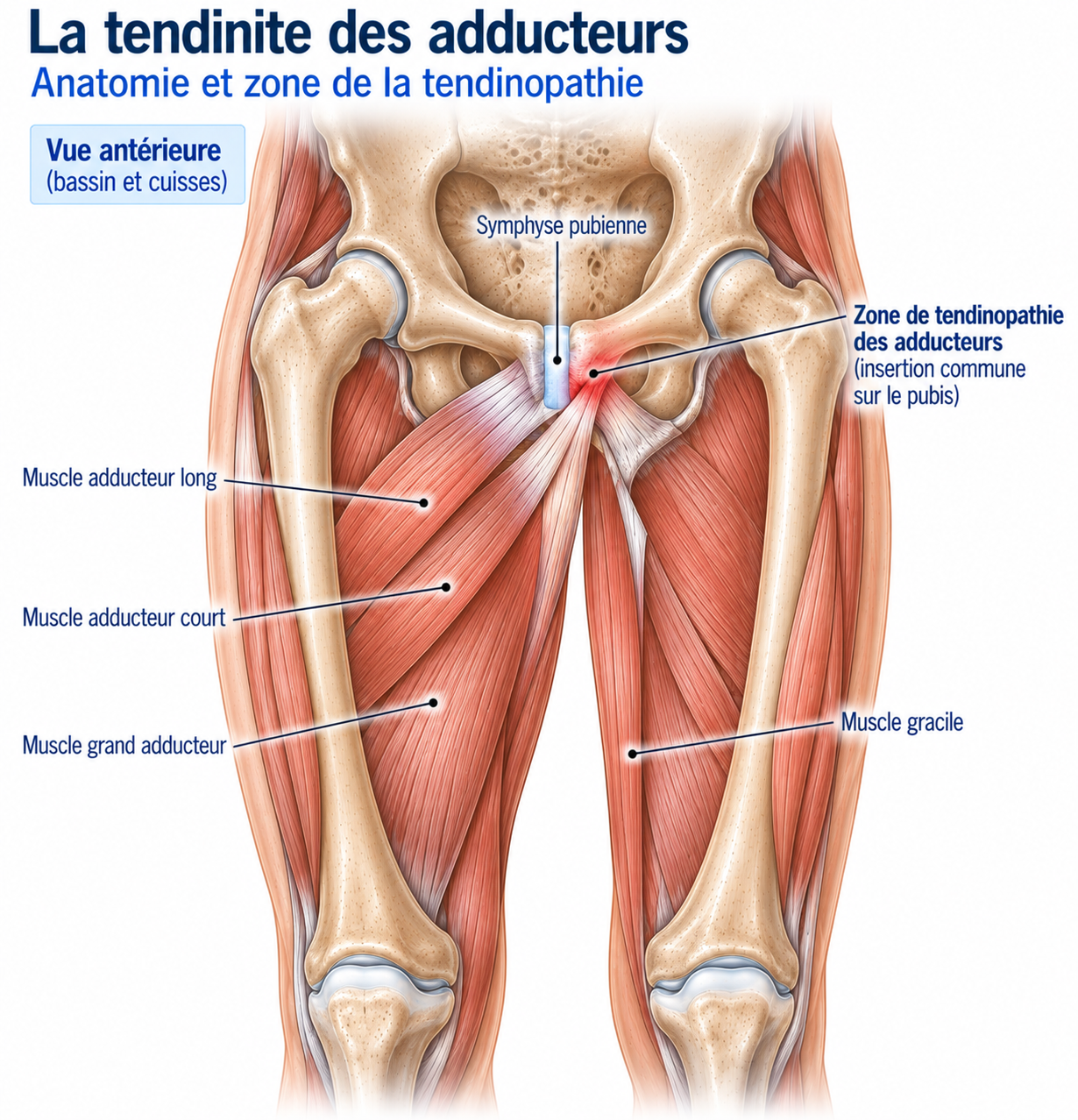
🔍 Click on the image to enlarge it
The adductor longus
The adductor longus is particularly important in adductor-related groin pain. It originates on the pubis and runs down to the medial part of the femur; its proximal tendon is a particularly stressed area during accelerations, changes of direction, kicking, lateral movements, slides and forced stretches. Imaging shows that adductor longus injuries are an important cause of groin pain in athletes.
Function and biomechanics
The adductors are not just for “closing the legs”: they help keep the femoral head in a stable position, contribute to pelvic control during single-leg movements, must brake and control lateral movements during changes of direction, contribute to the production and transmission of forces during accelerations, and are heavily loaded during the kicking movement in footballers.
The adductors are subjected to high stresses when the hip is in abduction, extension and rotation. The combination of marked abduction, hip extension and high speed can place heavy demands on the adductor complex — this is particularly the case during tackles, slides, changes of direction, kicking movements and rapid lateral movements.
Epidemiology
Adductor-related pain is particularly common in footballers, rugby players, hockey players, handball players, basketball players, tennis and padel players, sprinters, dancers and martial arts practitioners. It is particularly common in sports involving accelerations, decelerations, changes of direction, lateral movements and kicking.
Causes & risk factors
The most common mechanism is an imbalance between the load imposed and the capacity of the adductor complex to tolerate it. This can occur after a return to sport, an increase in training volume, more changes of direction, a return to football, more kicking or lateral work, or a sudden increase in speed. Pain may develop gradually or follow an initial muscle injury.
Tendinopathy or muscle injury?
In tendinopathy, pain develops gradually and is usually located in the groin or at the origin of the adductor longus. An acute muscle injury usually occurs suddenly during a sprint, a change of direction, a kick or a forced stretch, with sudden pain, a snapping sensation and loss of strength; a partial tear of the tendon origin can also occur, requiring management tailored to the severity of the injury.
Contributing factors
Load factors: abrupt return to sport, increase in intensity or volume, more frequent changes of direction, resumption of sprinting, more kicking or lateral work.
Muscular factors: adductor strength deficit, eccentric strength deficit, hip strength deficit, poor tolerance of rapid contractions.
Functional factors: impaired pelvic control, impaired hip stability, trunk strength deficit, poor tolerance of large-amplitude movements.
Symptoms
Athletes usually describe pain in the groin, especially when running fast or changing direction. At first, pain may appear only after training, the next day, or during explosive movements; it then appears while running, during accelerations, changes of direction or kicking. In chronic forms, it may become present during some everyday activities.
Pain is usually located in the groin, in the upper part of the thigh, near the pubis or at the origin of the adductor longus, and may sometimes spread towards the inner thigh, the pubic region or the lower abdomen — its exact location helps point towards the various possible causes of groin pain. Slow running may be well tolerated, with pain appearing more readily during accelerations, changes of pace, sprints or changes of direction: an athlete may therefore be able to run in a straight line without being ready to return to their sport. In footballers, kicking (which combines hip extension, rotation, high speed and dynamic adduction) is a particularly high load and must be reintroduced gradually.
Clinical examination
The examination looks at the precise location of the pain, tenderness on palpation and pain on resisted adduction, adductor strength, hip mobility, abdominal strength, pelvic control, and signs coming from the pubis, hip or inguinal region — the diagnosis must be reasoned within the overall context of groin pain. Palpation looks for tenderness at the origin of the adductor longus, the pubis and the upper part of the thigh.
Resisted adduction is one of the most important functional tests: the patient is asked to bring the leg towards the midline of the body against resistance, and reproduction of the usual pain supports the hypothesis of adductor involvement — strength must also be assessed, as pain alone without a deficit does not have the same significance as pain associated with a marked loss of strength. Squeeze tests (compression between the knees, at different angles of hip flexion) assess pain, strength and tolerance of contraction, and are useful for monitoring progress during rehabilitation — but no single test can determine the full origin of groin pain. Adductor strength should ideally be assessed objectively (handheld or portable dynamometer, isometric tests, side-to-side comparison) in order to identify a deficit, an asymmetry or poor tolerance of contraction.
The hip must always be examined (limited mobility, pain on movement, femoroacetabular impingement, strength deficit, functional instability), as hip pathology can cause pain resembling adductor pain. The pubic symphysis and abdominal structures must also be examined: pubic pain may be associated with adductor pain, and the different causes may coexist.
Further tests
Ultrasound
Used to assess the adductor longus and the other adductor tendons, muscle injuries, partial tears, certain insertion abnormalities and the surrounding soft tissues, with the possibility of dynamic assessment.
MRI
Particularly useful in complex cases: adductor longus tendinopathy, oedema at the tendon origin, fissuring, tear, avulsion, pubic or muscle involvement, hip pathology. In the context of adductor longus tendinopathy, an intratendinous tear is particularly suggestive; conversely, tendinosis, calcifications or bone irregularities can be found in athletes without pain — MRI must therefore always be interpreted alongside the clinical findings.
Differential diagnoses
Pubic pathology
Pain centred on the pubic symphysis.
Iliopsoas pathology
Anterior hip pain, particularly during active flexion.
Femoroacetabular impingement
Hip or groin pain reproduced by certain movements.
Labral tear
Can cause deep hip pain with mechanical symptoms.
Inguinal hernia
Groin pain or discomfort, sometimes associated with a swelling.
Abdominal pathology
Some abdominal pain can be felt in the groin.
Acute muscle injury
Sudden pain, snapping sensation, to be distinguished from the gradual onset of tendinopathy.
Stress fracture
To be considered in the case of persistent pain on impact.
Urological or gynaecological pathology
To be considered depending on the clinical context.
Classification
Stage 1
Pain after activity.
Stage 2
Pain during certain exercises but sport still possible.
Stage 3
Pain limiting accelerations, changes of direction or sports movements.
Stage 4
Significant pain during daily activities or suspicion of a significant structural injury.
Treatment
Load management and reducing irritability
Treatment is based above all on load management, progressive strengthening and sport-specific retraining — the available evidence shows that active treatments are generally more effective than passive treatments alone. Activities that overload the adductors (sprinting, changes of direction, lateral movements, kicking, tackles, plyometric work, splits, heavy adduction exercises) must be identified and exposure to them temporarily reduced; low-intensity straight-line running can often be maintained, by reducing speed, accelerations, changes of direction, hills and volume, and by monitoring the response over the following 24 hours.
During the phase of reducing irritability, start with isometric adduction (a ball or cushion between the knees, a gradual contraction held for 20 to 40 seconds, 4 to 5 repetitions), gradually increasing force and intensity according to tolerance.
Dynamic and then loaded strengthening
Band adduction, cable adduction, side-lying adduction, dynamic squeezes and functional movements are gradually introduced (for example band adduction, 3 sets of 10 to 15 repetitions), in order to gradually restore the capacity to produce force. Once pain is better controlled, the load is increased: cable adduction, modified Copenhagen plank, lateral lunges, lateral squats, single-leg exercises, loaded adduction — progressing load, range of motion, speed and volume.
The Copenhagen Adduction Exercise is particularly useful for developing adductor strength (thigh supported on a bench at beginner level, knee at intermediate level, foot at advanced level). A randomised study in footballers showed that a programme including the Copenhagen improved eccentric adduction strength, pain and several functional scores more than a programme without this exercise. However, it is very demanding and must not be introduced abruptly: the progression can follow simple isometrics → adduction with a light load → assisted Copenhagen → full Copenhagen → dynamic variations; it remains one tool among others, not a mandatory treatment.
Eccentric and unilateral work and the lumbopelvic chain
The adductors must be able to control movement while being gradually lengthened under load: dynamic Copenhagen, slow lateral lunge, lateral squat, eccentric cable adduction, gradually increasing range of motion, load and speed. Since sports movements are essentially asymmetrical, lunges, lateral lunges, step-ups, single-leg squats, single-leg Romanian deadlifts and single-leg Copenhagen are gradually introduced, with pelvic control becoming particularly important.
Since the adductors work in interaction with the abdominals, obliques, glutes, hamstrings, quadriceps and trunk muscles, rehabilitation must include pelvic and trunk control: the active programmes that achieved the best results combined strengthening of the adductors and abdominal muscles with coordination work.
Power work and sport-specific reintroduction
Once strength has been restored, speed must be reintroduced (rapid lateral movements, lateral bounds and jumps, accelerations, decelerations), moving from slow strength to fast strength and then to sport-specific strength. Changes of direction are reintroduced gradually: straight-line running, slight changes of direction, slow and then fast changes of direction, deceleration + change of direction, then sport-specific movements.
In footballers, kicking is reintroduced in stages: short passes, longer passes, moderate kicking, hard kicking, kicking on the run, kicking under pressure, then match-specific movements. Before returning to sprinting: well-tolerated heavy strengthening, strong adduction without significant pain, fast running tolerated, progressive accelerations tolerated and good pelvic stability — maximal sprinting should be one of the last stages. Being able to run straight ahead does not mean the adductors are ready for a team sport: the athlete must gradually tolerate slow and then fast changes of direction, decelerations, lateral movements and reactive movements.
Complementary treatments
Stretching
Not prohibited, but aggressive adductor stretching (wide abduction) can be irritating during the painful phase. The priority remains to gradually restore load capacity before seeking a large range of motion.
Massage and manual therapy
Can temporarily reduce pain, reduce feelings of tightness and make it easier to resume exercises, as a complement. The available evidence mainly supports the value of active management; passive treatments alone are of less value.
Shockwave therapy
Limited evidence in adductor tendinopathy. May be considered in some chronic forms, but not a first-line treatment.
Injections
To be considered with caution. May sometimes be discussed in certain specific situations after precise diagnostic confirmation of the structure responsible — groin pain is not an automatic indication for an injection.
PRP (platelet-rich plasma)
Insufficient evidence specific to chronic adductor tendinopathy to make it a standard treatment; should not replace properly conducted active rehabilitation.
Surgery
Surgery is rarely necessary. It may be considered in some chronic forms that are very disabling, resistant to well-conducted rehabilitation, or associated with a significant tendon injury. The literature suggests that it can be effective in some chronic adductor-related pain, but the evidence remains heterogeneous and of limited quality: rehabilitation therefore remains the first-line treatment.
Recovery time
The duration depends heavily on the situation: mild overload may improve within a few weeks, chronic tendinopathy may require several months, and a tear or avulsion may require longer rehabilitation. Important factors are how long the problem has been present, its severity, the sporting load, initial strength, the quality of rehabilitation and the presence of associated involvement. Historical studies on chronic adductor pain show that active programmes generally take several weeks, with protocols of around 8 to 12 weeks in some trials.
Prevention
Prevention of adductor-related pain relies on regular adductor strengthening, eccentric work, Copenhagen-type exercises, strengthening of the hip muscles, trunk work, and gradual exposure to accelerations and changes of direction. The Copenhagen is particularly useful as a strengthening and prevention tool: recent research confirms its ability to increase adduction strength, even though the optimal protocol and best dose remain to be determined.
Prevention is not just about strengthening: sudden changes in volume, intensity, sprinting, changes of direction or number of matches must also be avoided. A player returning after several weeks off should not immediately return to the same exposure to stress as in mid-season.
Frequently asked questions
Is it really a tendinopathy?
Which tendon is most often affected?
Can I run?
Can I keep playing football?
Is the Copenhagen mandatory?
Is stretching recommended?
Is an MRI necessary?
Can you have tendinopathy and pubalgia at the same time?
Can adductor pain come from the hip?
When can you return to sprinting?
When can I resume changes of direction?
Common mistakes
Calling any groin pain "adductor tendinopathy", when the inguinal region contains many structures.
Stopping sport completely, when reducing the load is often preferable to complete rest.
Only doing stretches, when the adductors above all need to regain their strength capacity.
Starting straight away with the full Copenhagen, which may be too demanding at first.
Returning to sprinting too early, when speed is a significant load.
Resuming changes of direction too early: they must be reintroduced gradually.
Neglecting the trunk, when the adductors work together with the pelvis and the abdominal wall.
Treating only the pain, when the goal is to restore functional capacity.
Relying solely on MRI, when imaging abnormalities can be present in asymptomatic athletes.
Key points — Institut Basque du Coureur
"Adductor tendinopathy" most often corresponds to adductor-related groin pain, frequently centred on the origin of the adductor longus. But groin pain can also come from the pubis, the psoas, the hip, the inguinal region or the abdominal wall, and several causes may be present at the same time. Diagnosis is therefore based above all on the history, the location of the pain, the clinical examination and functional tests, with imaging when necessary. Treatment is mainly based on load management, progressive adductor strengthening, pelvic and trunk work, a gradual return to running and the reintroduction of accelerations and changes of direction. The Copenhagen can be an excellent strengthening tool, but it must be introduced gradually, following the progression strength → strength through a large range of motion → power → speed → changes of direction → sport-specific movements. Groin pain is not a diagnosis: the first step is to identify which structure is actually responsible for the pain. An adductor that is ready to return to sport is not merely pain-free: it must be able to produce, absorb and repeat the forces imposed by the sport.
- Weir A, Brukner P, Delahunt E, et al. Doha agreement meeting on terminology and definitions in groin pain in athletes. Br J Sports Med. 2015;49(12):768-774.
- Falvey ÉC, Franklyn-Miller A, McCrory PR. The groin triangle: a clinical examination update. Br J Sports Med.
- Schache AG, Crossley KM, Macindoe IG, et al. Adductor-related groin pain in competitive athletes. Role of adductor enthesis, magnetic resonance imaging, and entheseal pubic cleft injections. J Bone Joint Surg Am. 2007.
- Holmich P, Uhrskou P, Ulnits L, et al. Effectiveness of active physical training as treatment for long-standing adductor-related groin pain in athletes: randomised trial. Lancet. 1999;353:439-443.
- Holmich P, Nyvold P, Larsen K. Continued sports activity during treatment for longstanding adductor-related groin pain. Am J Sports Med.
- Serner A, van Eijck CH, Beumer BR, et al. Study quality on groin injury management remains low: a systematic review on treatment of groin pain in athletes. Br J Sports Med. 2015.
- Charlton PC, Drew MK, Mentiplay BF, et al. Exercise Interventions for the Prevention and Treatment of Groin Pain and Injury in Athletes: A Critical and Systematic Review. Sports Med. 2017;47:2011-2026.
- Bisciotti GN, Volpi P, Zini R, et al. The conservative treatment of longstanding adductor-related groin pain syndrome: a critical and systematic review. Biol Sport. 2021.
- Ramazzina I, Bernazzoli B, Braghieri V, Costantino C. Groin pain in athletes and non-interventional rehabilitative treatment: a systematic review. J Sports Med Phys Fitness. 2019.
- Serner A, Mosler AB, Tol JL, Crossley KM. Progression of strength and running rehabilitation after acute adductor injuries in athletes.
- Taylor R, Vuckovic Z, Mosler AB, et al. Multidisciplinary Assessment of 100 Athletes With Groin Pain Using the Doha Agreement. Clin J Sport Med. 2018;28:364-369.
- The effectiveness of the Copenhagen adduction exercise on improving eccentric hip adduction strength among soccer players with groin injury. J Sports Sci. 2024.