
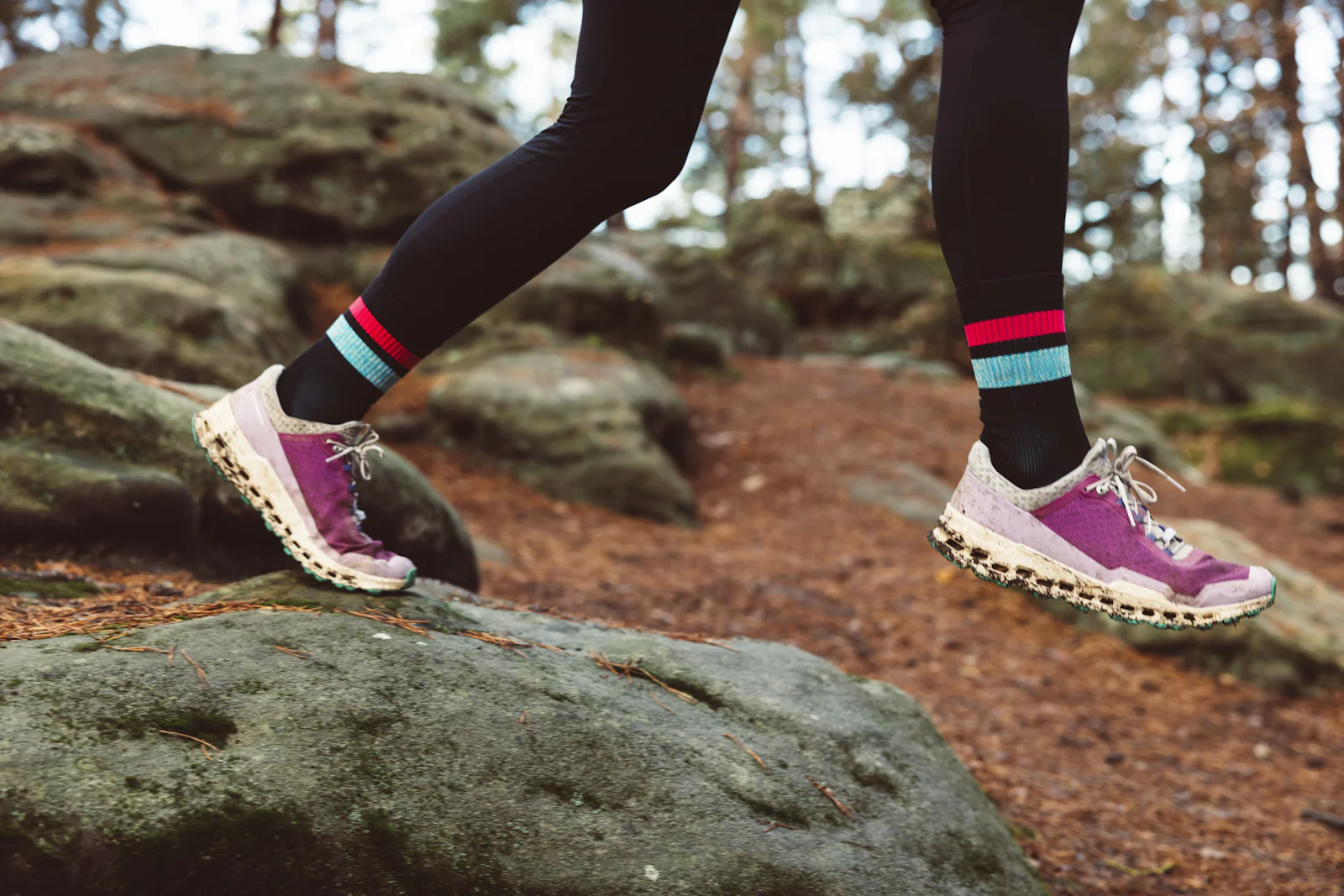
The running shoe is the interface between the foot and the ground. It plays an important role in the runner’s comfort and in managing the mechanical stresses of running. [1–3]
It is important to bear in mind, however, that a shoe doesn’t fix everything. It supports the foot’s movement but replaces neither progressive training nor good recovery. [2,4]
Key message: A suitable shoe can improve running comfort, but an unsuitable shoe can promote certain injuries. [1–3]
👟 What is a running shoe for?
Attenuates some of the impacts with each stride and reduces certain stresses on bones, tendons and joints.
[5,7]The structure helps limit certain excessive foot movements during ground contact.
[1]Protects against uneven ground, stones, friction and temperature changes.
Some models return part of the mechanical energy and slightly improve stride efficiency.
[6]🔍 How to choose the right shoe
Criterion no. 1 01
A good shoe should be comfortable from the first fitting, with no pressure points or compression.
- No immediate pain
- Holds the foot without squeezing
- Comfortable from the very first step
➡️ Comfortable when trying on = often the right choice [1,4]
For running, allow 0.5 to 1 cm in front of the toes to anticipate the foot swelling during exercise. [7]
- Too small: black toenails, blisters, pain
- Too big: instability, friction
➡️ Always try shoes on at the end of the day, when feet are swollen
The aim is appropriate, not maximal, cushioning. It depends on weight, volume and terrain. [5]
- Insufficient: increased bone stress
- Excessive: loss of ground feel, instability
➡️ More cushioning ≠ better protection
Heel-to-forefoot difference 04
Influences the stresses on the calf and Achilles tendon. [8]
- 8–12 mm: less stress on the calf but more on the knee
- 0–6 mm: more stress on the foot and calf but less on the knee
➡️ Any change of drop must be gradual [8]
Can be useful in case of fatigue, long distances or a history of injury. [1,4]
- Systematic pronation correction: less recommended today
- Choice based on perceived comfort
➡️ Comfort first, not mechanical correction
Directly influences running feel and the level of protection. [6]
- Light: more dynamic → racing
- Heavier: more protective → training
➡️ Keep racing models for competition, if tolerated
📐 Understanding drop
Drop is the difference in height between the heel and the forefoot. It affects how stresses are distributed across the whole musculotendinous chain. [8]
- Reduces stress on the calf
- Protects the Achilles tendon
- Encourages heel strike
- Recommended when returning to running or with an Achilles injury
- Works the foot muscles harder
- Encourages midfoot or forefoot strike
- Can improve running feel
- Gradual transition essential
Changing drop = mandatory transition. Any change must be gradual to allow the muscles and tendons to adapt. Never change drop radically during a competition period or a period of heavy training load. [8]
🗺️ Choosing by discipline
Even cushioning, a relatively flexible sole and moderate stability. Grip is not a priority.
Sole with pronounced grip, reinforced protection against rocks and better foot hold on uneven terrain.
Comfort becomes the priority. Look for more volume, stability and durability for long distances.
Why rotate several pairs?
- ▸Spread the mechanical stresses
- ▸Let the foams recover between sessions
- ▸Reduce the risk of injury [9]
Ideal: 2 to 3 different pairs depending on the type of training
When should you replace your shoes?
Approximate lifespan: 600 to 800 km [5]
- ▸New pain appearing
- ▸Compressed midsole or loss of stability
- ▸Marked wear of the outsole
🚫 Common misconceptions
Several beliefs about footwear persist. Here is what the scientific literature says. [1–4]
❌ The more cushioned a shoe, the better +
❌ There is a perfect shoe for every runner +
❌ A shoe can fully correct overpronation +
✅ Key messages to remember
A shoe that is comfortable from the first fitting is often the right choice. It is the most reliable signal available to the runner. [1]
Changing shoes alters the stresses applied to the body. Any transition — especially in drop — must be gradual. [2,8]
Having 2 to 3 different pairs varies the mechanical demands and extends the lifespan of each model. [9]
They support movement but are no substitute for well-dosed progression or strength training. [4]
Choosing a running shoe is above all a matter of comfort and individual fit. No model suits everyone. The number one criterion remains how it feels when you try it on. Any change must be gradual to give the body time to adapt. The shoe is one tool among others: it replaces neither technique, nor progressive training, nor recovery.
- Nigg BM, et al. Running shoes and injury prevention. Sports Med. 2015.
- Nielsen RO, et al. Footwear and running injuries. Sports Med. 2014.
- Richards CE, et al. Footwear and running injury risk. Br J Sports Med. 2009.
- Napier C, et al. Rethinking running footwear. Br J Sports Med. 2015.
- Shorten MR. Running shoe design and cushioning. Sports Med. 2000.
- Hoogkamer W, et al. Running economy and shoe technology. Nature. 2018.
- Novacheck TF. The biomechanics of running. Gait Posture. 1998.
- Chambon N, et al. Influence of shoe drop on running biomechanics. Eur J Sport Sci. 2015.
- Malisoux L, et al. Use of multiple shoes and injury risk. Scand J Med Sci Sports. 2015.