

Strength training plays an essential role in running, both for performance and for injury prevention. By improving the strength of the legs, trunk and stabilising muscles, it allows a more efficient stride, better stability and improved running economy.
It also helps absorb the repeated impacts of running more effectively, thereby reducing the risk of pain or injury. Included regularly in training, strength training therefore helps you run longer, faster and with less fatigue.
🎯 Goals
💪 Muscles to strengthen + exercises
Gluteus maximus & medius 01
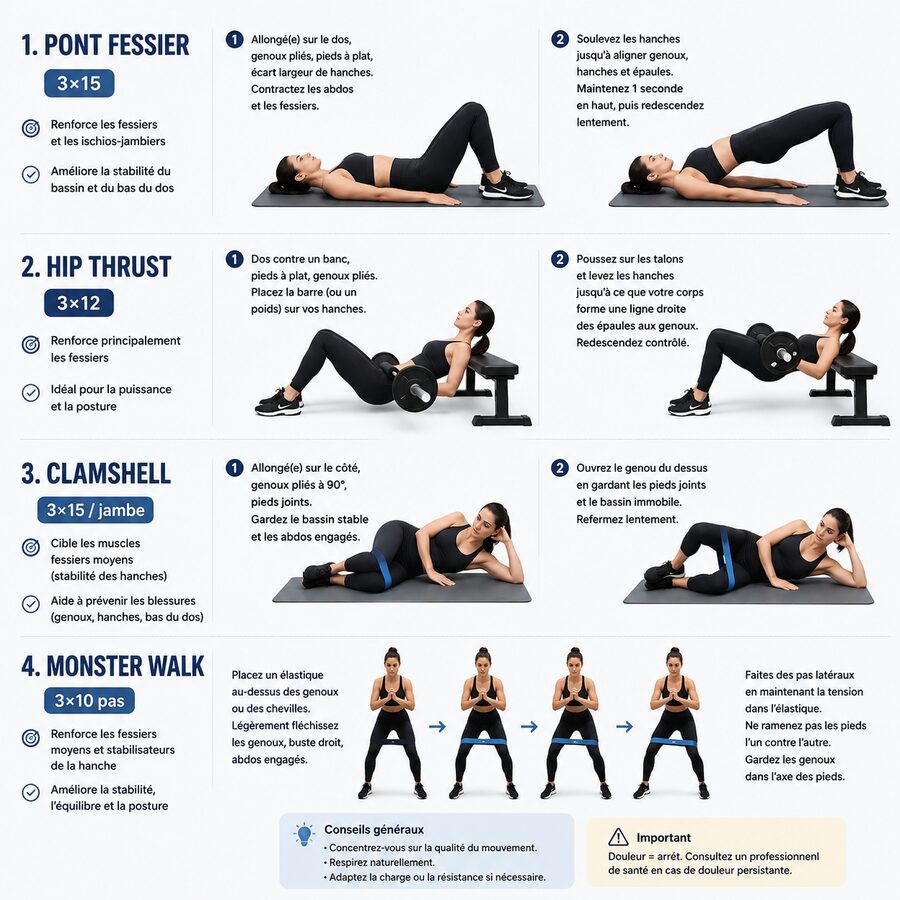
Pelvic stability, knee control [2, 4]
- Glute bridge3×15
- Hip thrust3×12
- Clamshell3×15/leg
- Monster walk3×10 steps
➡️ Weakness associated with knee injuries and patellofemoral pain syndrome [2, 6]
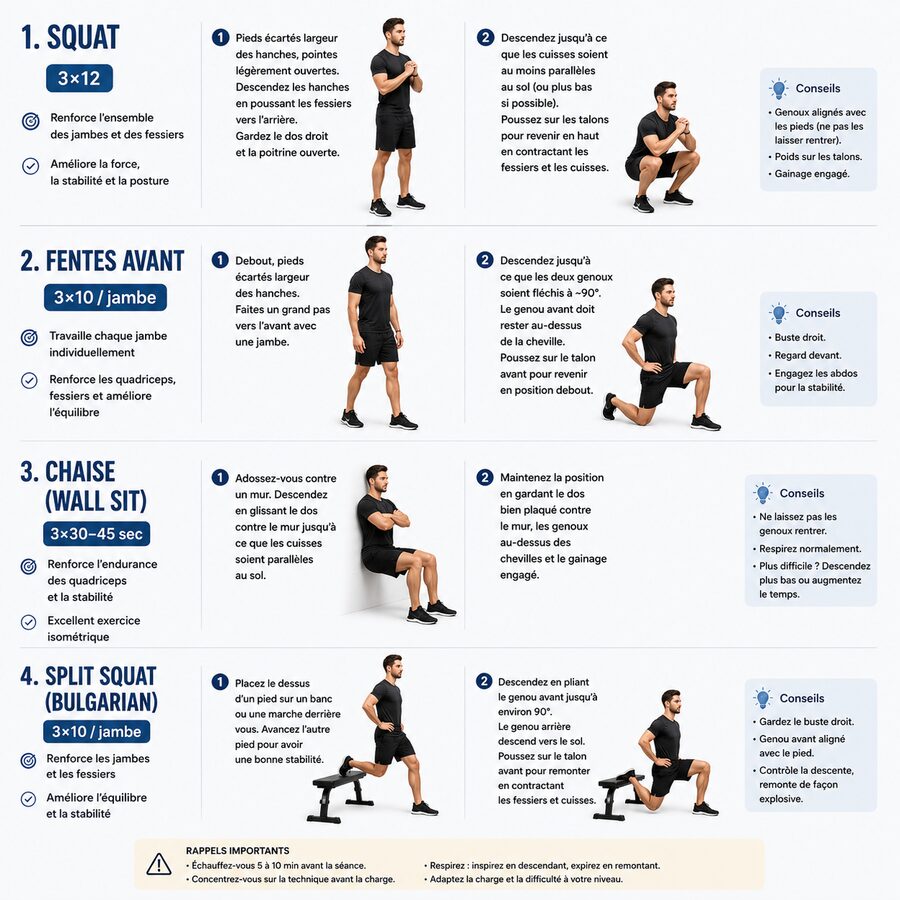
Shock absorption, prevention of patellar conditions [1, 7]
- Squat3×12
- Forward lunges3×10/leg
- Wall sit3×30–45 sec
- Split squat3×10/leg
➡️ Key role in managing vertical forces when running [5, 7]
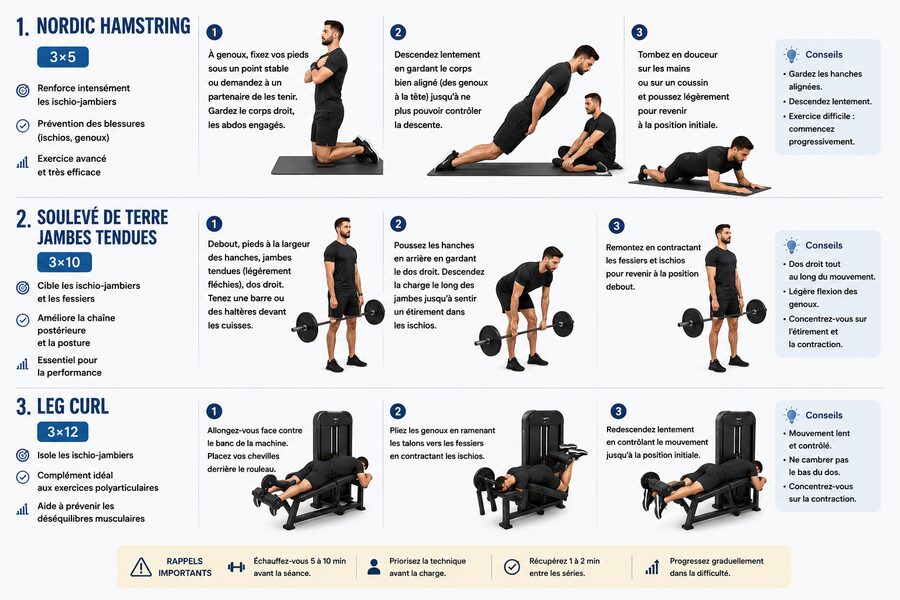
Propulsion, prevention of muscle injuries [3, 8]
- Nordic hamstring3×5
- Stiff-legged deadlift3×10
- Leg curl3×12
➡️ Eccentric exercises are particularly effective at reducing injury risk [8]
Calves 04
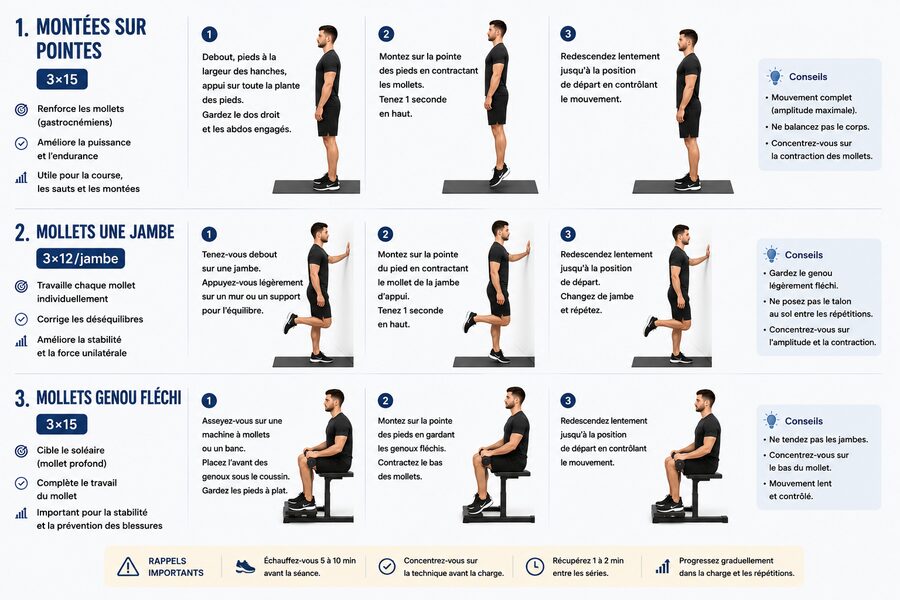
Propulsion, protection of the Achilles tendon [3, 9]
- Calf raises3×15
- Single-leg calf raises3×12
- Bent-knee calf raises3×15
➡️ Essential for returning elastic energy when running [5, 9]
Abs + lower back 05
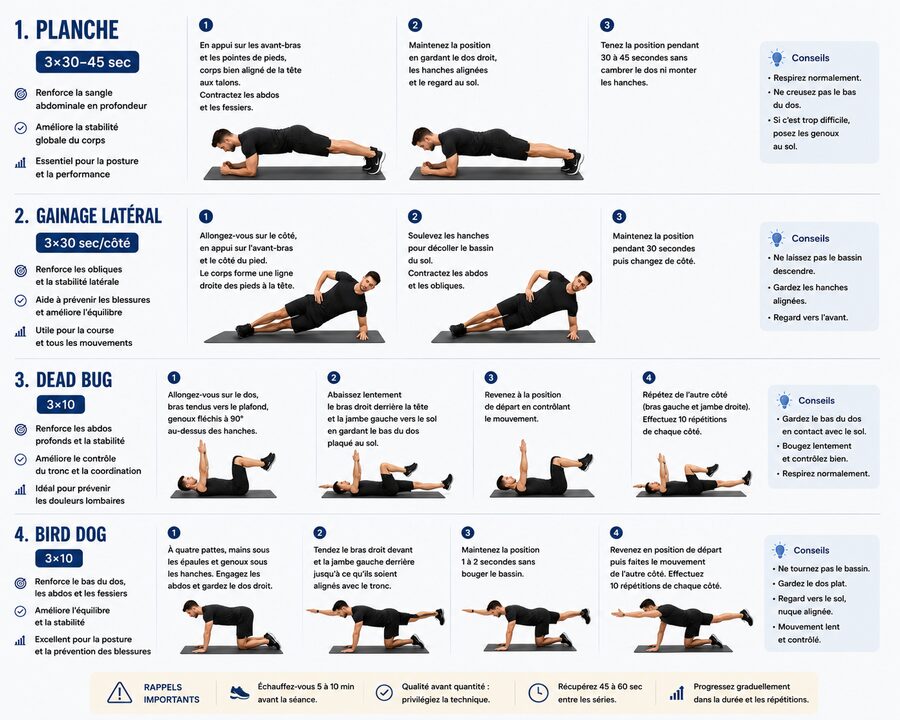
Overall stability, posture, prevention of low back pain [4, 10]
- Plank3×30–45 sec
- Side plank3×30 sec/side
- Dead bug3×10
- Bird dog3×10
➡️ Improves trunk control and reduces compensations [4]
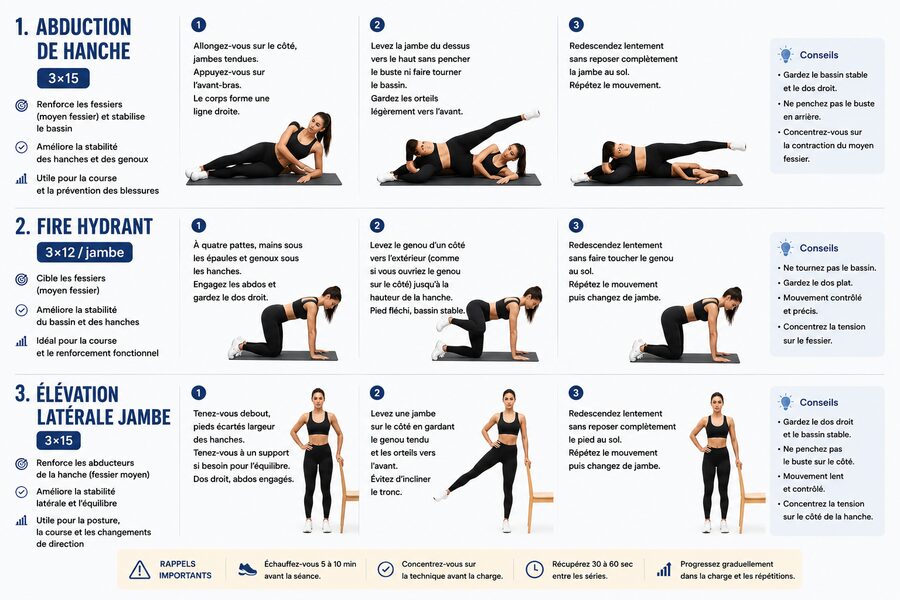
Pelvic stability, prevention of TFL-type injuries [2, 6]
- Hip abduction3×15
- Fire hydrant3×12/leg
- Side-lying leg raise3×15
➡️ Major role in controlling knee valgus [6]
📅 Weekly programme (example)
- Squat 3×12
- Lunges 3×10/leg
- Glute bridge 3×15
- Standing calf raises 3×15
- Plank 3×30–45 sec
- Clamshell 3×15/leg
- Nordic hamstring 3×5
- Dead bug 3×10
- Side plank 3×30 sec/side
- Single-leg calf raises 3×12
Example of a typical week
✅ Practical tips
- Prioritise technique before increasing load or volume. Good execution protects the joints and maximises the benefits. [1]
- Start with bodyweight — master the fundamental movements before adding resistance or dumbbells. [1, 3]
- Be consistent (≥ 2 sessions/week) — consistency matters more than intensity. Short, frequent sessions are more effective than an intense, occasional one. [3]
- Duration: 20 to 30 minutes per session — enough to achieve significant neuromuscular adaptations without adding to the overall training load.
Strength training is associated with a significant reduction in injury risk in runners — up to 50% according to some meta-analyses. Included regularly in training, it improves both musculoskeletal robustness and running economy. Two 20- to 30-minute sessions per week are enough to reap the full benefits. [1–3]
- Lauersen JB, et al. Exercise interventions for prevention of sports injuries. Br J Sports Med. 2014.
- Ferber R, et al. Strengthening of the hip and knee muscles. Clin Biomech. 2011.
- Blagrove RC, et al. Strength training for endurance runners. Sports Med. 2018.
- Fredericson M, et al. Core stability in runners. Phys Med Rehabil Clin N Am. 2005.
- Barnes KR, Kilding AE. Running economy and strength training. Sports Med. 2015.
- Powers CM. The influence of hip strength on knee mechanics. J Orthop Sports Phys Ther. 2010.
- Esculier JF, et al. Quadriceps strengthening in runners. Br J Sports Med. 2015.
- van Dyk N, et al. Nordic hamstring exercise and injury prevention. Br J Sports Med. 2019.
- Maffiuletti NA, et al. Calf muscle function and Achilles tendon. J Appl Physiol. 2008.
- Akuthota V, Nadler SF. Core strengthening. Arch Phys Med Rehabil. 2004.