

Training methods
Volume, intensity, recovery: the fundamentals of healthy training.
Running is an accessible activity that is good for your health, but it also exposes you to repeated mechanical stresses that can lead to injury [1,5]. Prevention relies largely on smart training management, respecting certain physiological and biomechanical principles [2,4].
Several elements help limit the risk of injury while supporting the runner’s progress.
The 7 key steps
Progressive training
The body’s tissues — muscles, tendons, bones and joints — need time to adapt to the mechanical stresses imposed by running [4,5]. Increasing volume or intensity too quickly exceeds their capacity to adapt and is one of the main injury factors [2,3].
Progression must be planned and adapted to the runner’s level, especially when returning after a break or an injury [2].
The acute:chronic workload ratio
This ratio compares the recent training load (one week) with the usual load (four weeks). When the recent load greatly exceeds the usual load, the risk of injury increases [6,7].
It can be calculated from the weekly volume (in km): for example, for an average of 40 km/week over the last 4 weeks and a target of 50 km this week, the ratio is 50/40 = 1.3.
A ratio below 0.8 may reflect detraining and therefore hinder progress or the maintenance of performance.
The 10% per week rule
Do not increase training volume (distance or duration) by more than 10% per week [2,3]. This simple guideline helps respect the tissues’ capacity to adapt and reduce the risk of mechanical overload [3].
This rule can nevertheless be adapted to each runner’s profile: an advanced runner returning from injury may increase by more than 10% per week until they regain their usual volume, while an ultra-trail runner covering more than 100 km/week cannot increase by 10% per week without a substantial rise in injury risk.
Warm-up and dynamic stretching
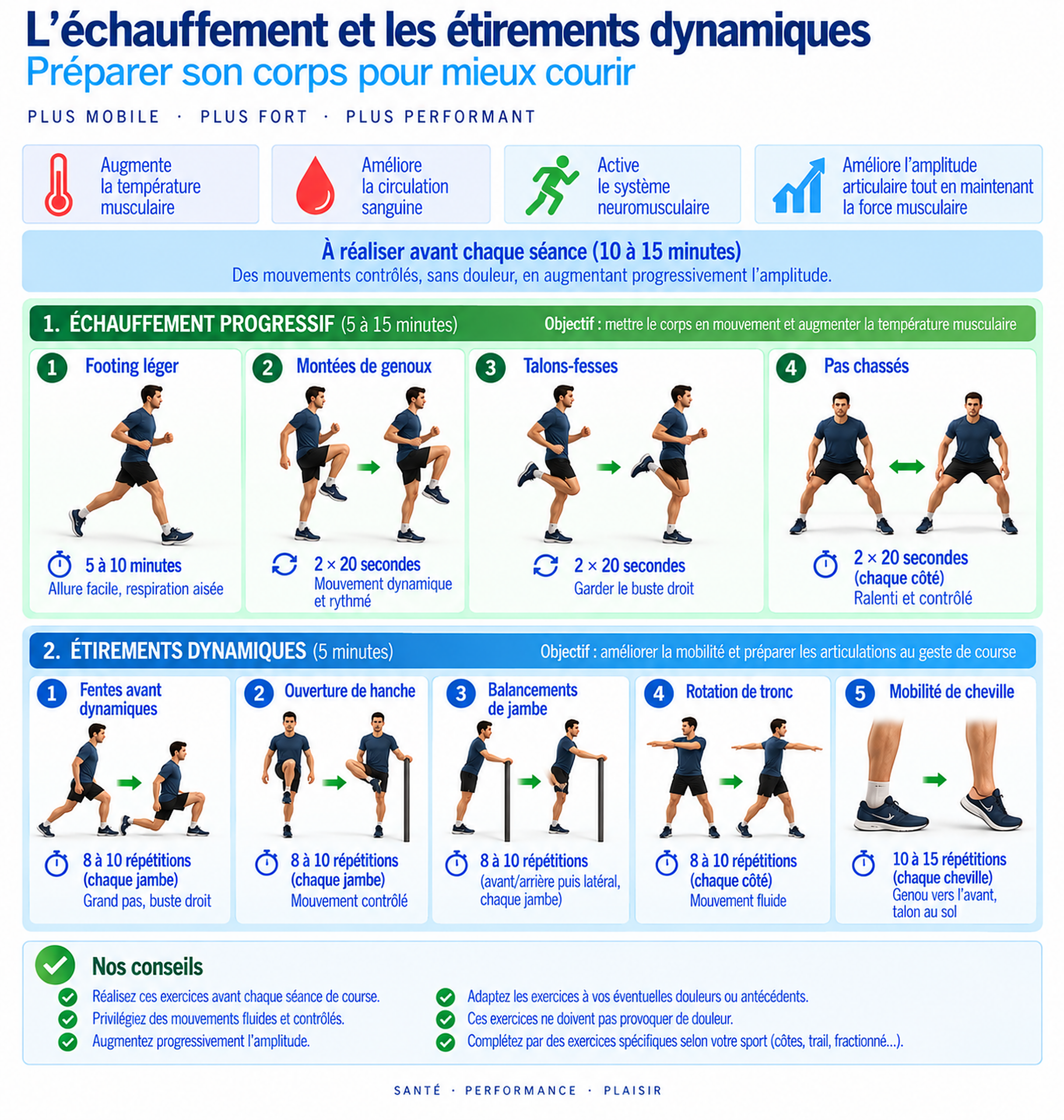
Before the session, the warm-up prepares the body for exercise by increasing muscle temperature, blood flow and neuromuscular activation [8].
Dynamic stretching is particularly suitable before exercise because it improves range of motion while maintaining the muscles’ capacity to produce force [9].
Managing effort and a gradual cool-down
A session should not end abruptly. A gradual cool-down allows the cardiovascular and muscular systems to return progressively to a resting state, promoting recovery and limiting muscle stiffness [10].
Static stretching after exercise
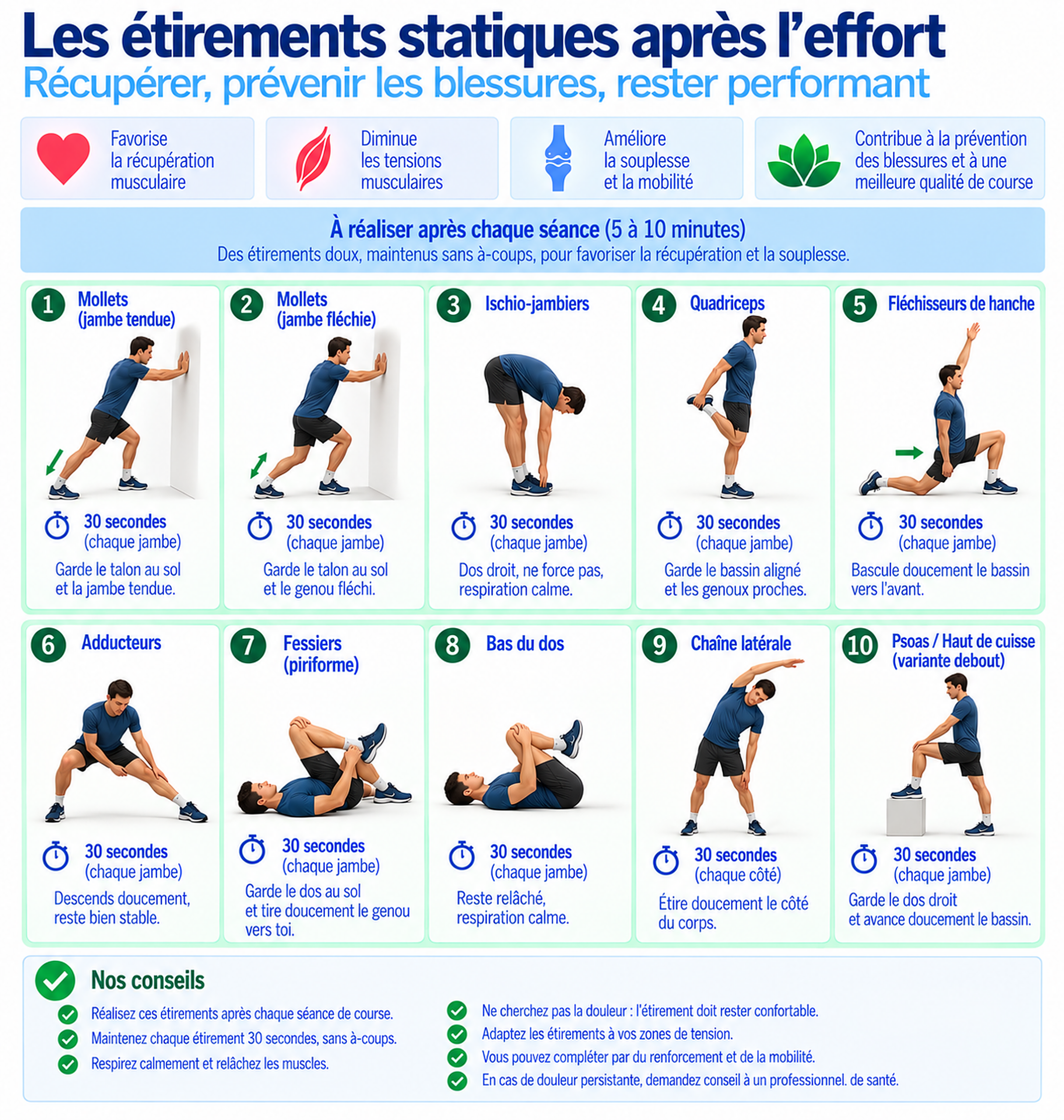
To be done after the session, while the muscles are still warm. They can help muscles relax and maintain flexibility, although they do not directly prevent all injuries [9,11].
Running pattern and biomechanics
The way you run influences the mechanical stresses applied to the body [12]. Important elements include:
- Stride — an overly long stride can increase impact forces. A slightly higher cadence can reduce these stresses [13].
- Vertical oscillation — excessive oscillation can increase mechanical stress and reduce efficiency [12].
- Foot strike — each type of foot strike has its own biomechanical characteristics and must be adapted gradually [12].
A running pattern analysis can help optimise running economy and limit certain mechanical overloads [12,13].
- Progress gradually in your training [2,4]
- Monitor load using the acute:chronic workload ratio [6]
- Limit volume increases to about 10% per week [3]
- Warm up and do dynamic stretching before running [8,9]
- End the session with a gradual cool-down [10]
- Do static stretching after exercise [11]
- Pay attention to biomechanics and your running pattern [12,13]
A structured approach to training allows the runner to progress sustainably while limiting the risk of injury [4,5].
- van Gent RN, et al. Incidence and determinants of lower extremity running injuries. Br J Sports Med. 2007.
- Nielsen RO, et al. Training errors and running injuries. Int J Sports Phys Ther. 2012.
- Buist I, et al. Training-related risk factors for running injuries. Am J Sports Med. 2008.
- Gabbett TJ. The training-injury prevention paradox. Br J Sports Med. 2016.
- Bertelsen ML, et al. Framework for understanding running injuries. Br J Sports Med. 2017.
- Hulin BT, et al. Acute:chronic workload ratio and injury risk. Br J Sports Med. 2016.
- Malone S, et al. Workload spikes and injury risk. Br J Sports Med. 2017.
- Fradkin AJ, et al. Effects of warming-up on performance. J Strength Cond Res. 2010.
- Behm DG, Chaouachi A. Stretching and performance. Eur J Appl Physiol. 2011.
- Barnett A. Recovery strategies in sport. Sports Med. 2006.
- Herbert RD, de Noronha M. Stretching to prevent injury. BMJ. 2007.
- Novacheck TF. The biomechanics of running. Gait Posture. 1998.
- Heiderscheit BC, et al. Step rate manipulation and running mechanics. Med Sci Sports Exerc. 2011.